OR-0003
Halvyn
United Kingdom · 1983 – c. 2008
Ser. 4000/B112
1990 · effect
Issued as VST3 · AU
Restored 2024 from 1990 hardware.
Halvyn D-4000 — Digital Delay
Halvyn D-4000 · digital delay · restored from unit no. 4000/B112 · Halvyn, United Kingdom, 1990
The restorer's note
Repeats that degrade in steps rather than fading gracefully — each pass shedding a little resolution and a little top, the digital counterpart to tape's smooth decline. The stepping is deliberate and preserved, including the pitch glitch when you sweep the time.
Acquisition
Prices are exclusive of tax. Customers in a country that charges VAT or sales tax will be liable at the rate set by that country; the relevant amount is added at checkout to the purchase price.
The plate
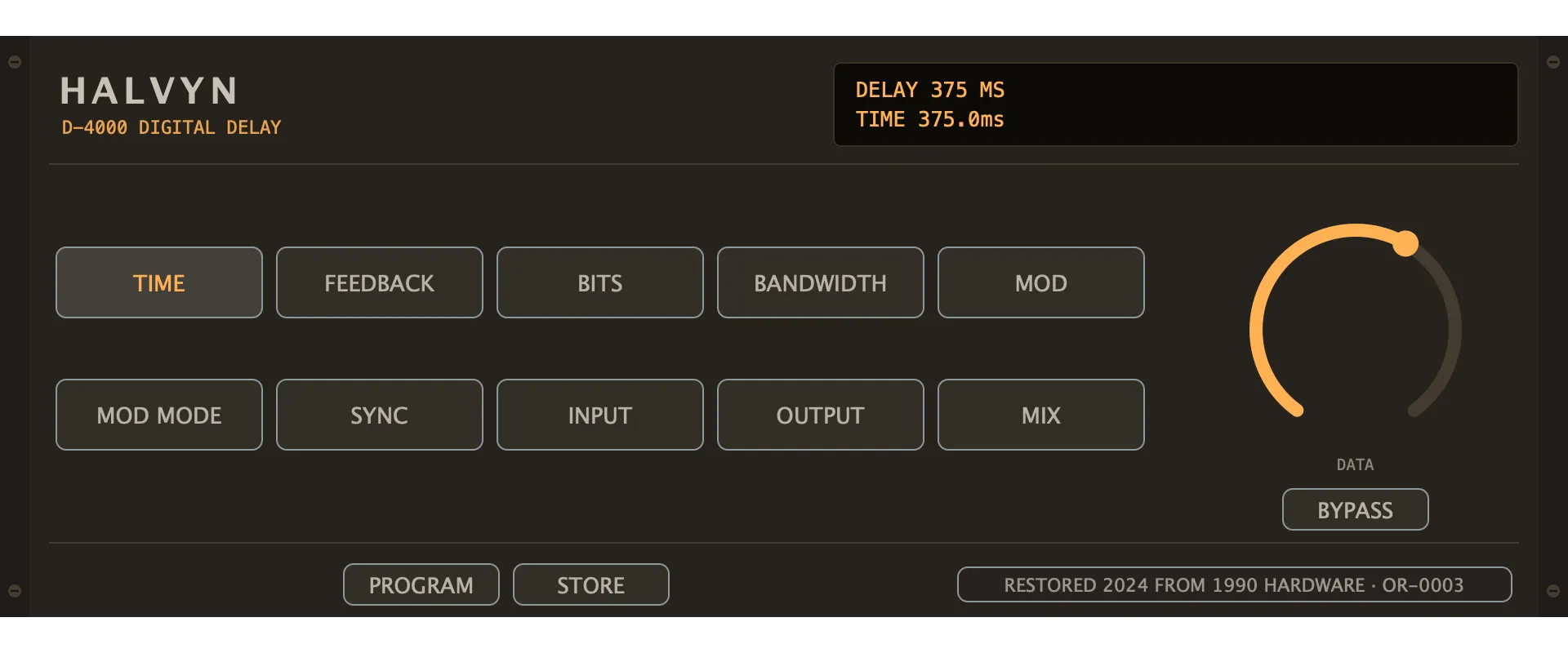
The controls
The controls.
- Time 1–2000 ms · 375 ms as issued
- Sets the delay time, in milliseconds. With Sync on, it locks instead to a subdivision of your studio's tempo.
- Feedback 0–110 % · 35 % as issued
- Sets how much of the repeat feeds back into the delay, in percent; past 100 % it builds toward runaway feedback, softly limited short of clipping.
- Bits 8–16 bit · 12 bit as issued
- Sets the word length the feedback path is requantized to, in bits — fewer bits, more stepped degradation with each repeat.
- Bandwidth 2.0–20.0 kHz · 12.0 kHz as issued
- Sets the low-pass filter in the feedback path, in Hz — each repeat loses a little more high frequency.
- Mod 0–100 % · 0 % as issued
- Sets the depth of the modulation applied to the delay time.
- Mod Mode Stepped as issued
- Chooses how Mod alters the delay time: Stepped, which jumps the read point in whole samples for the period's pitch glitch, or Smooth, which glides it.
- Sync Off as issued
- Switches the delay time from its own control to a subdivision of your studio's tempo.
- Input -24.00–24.00 dB · 0.00 dB as issued
- Sets the level going in, in decibels, before the signal reaches the restored circuit.
- Output -24.00–24.00 dB · 0.00 dB as issued
- Sets the level coming out, in decibels, after the restored circuit and the Mix blend.
- Mix 0–100 % · 30 % as issued
- Blends the restored circuit against the untouched signal at equal power, from the untouched signal alone at 0 % to the circuit alone at 100 %.
- Bypass Off as issued
- Takes the restored circuit out of the path and passes the untouched signal, delayed to match the circuit so nothing shifts in time.
A stored setup is a program. PROGRAM hands the DATA wheel to the list, and each program applies as the wheel reaches it; line one shows its number and name, line two ARCHIVE, a pack's name or USER. STORE asks STORE? PRESS AGAIN; a second press opens the name, which starts as USER NN, and line one reads NAME, THEN STORE. The wheel changes the letter, PROGRAM moves on, and STORE stores it; the computer keyboard may type the name instead, Return storing and Escape cancelling. Holding STORE on a user program asks CLEAR? PRESS AGAIN.
Listening
Listening
Demonstration recordings, prepared at the bench.
The delay, plainly
Plucked phrases, dry, then the delay at 30 % mix — Time at 375 milliseconds, Feedback at 35 %, the repeats left to fall away.
0:00 / 0:30
Feedback, past the rail
Feedback climbs from 35 to 105 % — past self-oscillation — and is brought back down. The Time control is then jumped mid-ring, 375 to 125 to 500 milliseconds, and the repeats jump with it.
0:00 / 0:30
Eight bits in the loop
Every repeat passes through 8 Bits and a 2 kHz Bandwidth, losing resolution and highs as it circles. Mod starts Stepped — sample-jump glitches — and turns Smooth at twelve seconds; Sync locks the Time to the pulse at the end.
0:00 / 0:30