OR-0009
Halvyn
United Kingdom · 1983 – c. 2008
Ser. 7000/B061
1992 · effect
Issued as VST3 · AU
Restored 2024 from 1992 hardware.
Halvyn E-7000 — Digital EQ
Halvyn E-7000 · digital equaliser · restored from unit no. 7000/B061 · Halvyn, United Kingdom, 1992
The restorer's note
Early digital equalisation, brittle edge and all — the slightly glassy top and the cramping near Nyquist that engineers argued about for years. We restored the argument rather than settle it; the coefficient character is exactly as it was.
Acquisition
Prices are exclusive of tax. Customers in a country that charges VAT or sales tax will be liable at the rate set by that country; the relevant amount is added at checkout to the purchase price.
The plate
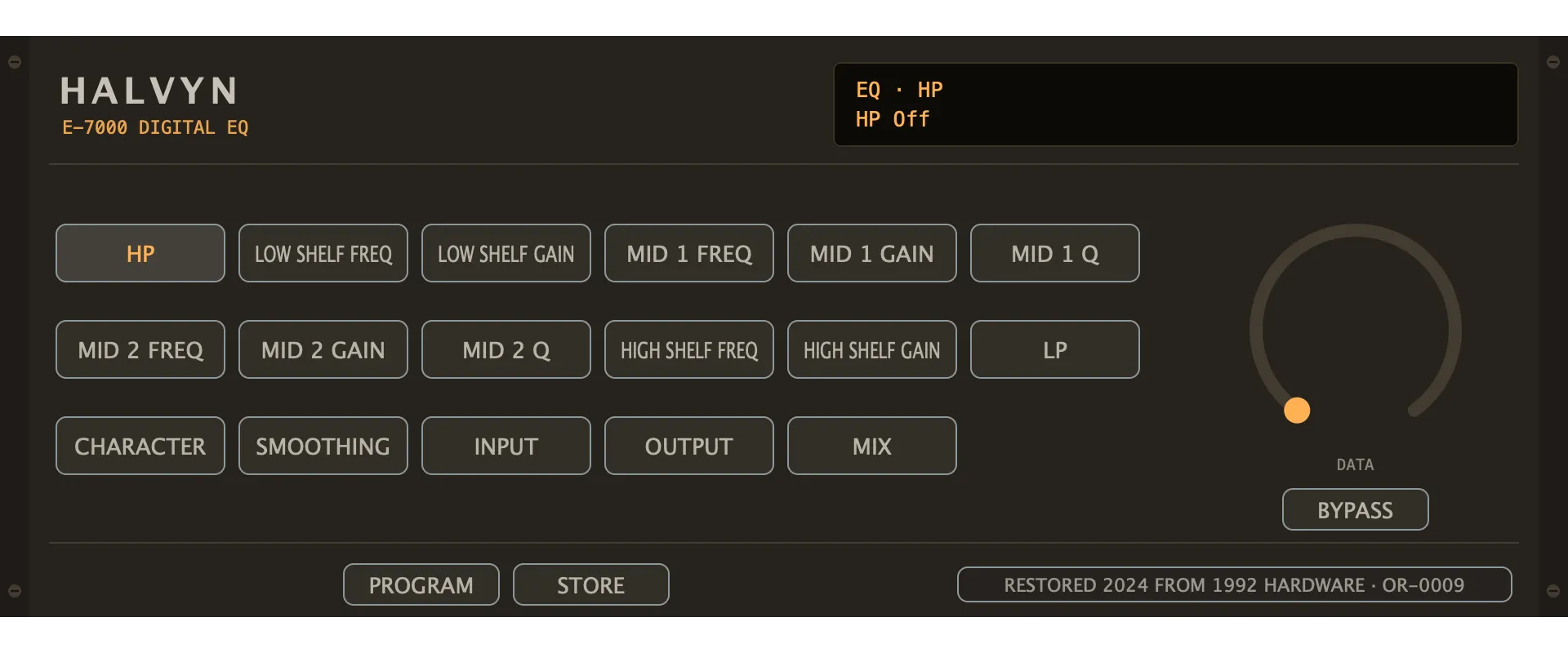
The controls
The controls.
- HP Off–500 Hz · Off as issued
- Sets the high-pass filter's corner, in Hz; below 20 Hz the control reads Off and leaves the signal untouched.
- Low Shelf Freq 20–500 Hz · 100 Hz as issued
- Sets the low shelf's corner frequency, in Hz.
- Low Shelf Gain -18.0–18.0 dB · 0.0 dB as issued
- Sets the low shelf's boost or cut, in decibels.
- Mid 1 Freq 100 Hz–10.0 kHz · 500 Hz as issued
- Sets Mid 1's centre frequency, in Hz — the first parametric band.
- Mid 1 Gain -18.0–18.0 dB · 0.0 dB as issued
- Sets Mid 1's boost or cut, in decibels.
- Mid 1 Q 0.30–10.00 · 1.00 as issued
- Sets Mid 1's bandwidth — the Q of the first parametric band; a higher value narrows it.
- Mid 2 Freq 100 Hz–10.0 kHz · 3.0 kHz as issued
- Sets Mid 2's centre frequency, in Hz — the second parametric band.
- Mid 2 Gain -18.0–18.0 dB · 0.0 dB as issued
- Sets Mid 2's boost or cut, in decibels.
- Mid 2 Q 0.30–10.00 · 1.00 as issued
- Sets Mid 2's bandwidth — the Q of the second parametric band; a higher value narrows it.
- High Shelf Freq 2.0–20.0 kHz · 8.0 kHz as issued
- Sets the high shelf's corner frequency, in Hz.
- High Shelf Gain -18.0–18.0 dB · 0.0 dB as issued
- Sets the high shelf's boost or cut, in decibels.
- LP 2.0 kHz–Off · Off as issued
- Sets the low-pass filter's corner, in Hz; above 20 kHz the control reads Off and leaves the signal untouched.
- Character 0–100 % · 50 % as issued
- Sets how far the filter coefficients are coarsened toward the period's cramped, glassy character, from clean at 0 % to the full digital edge at 100 %.
- Smoothing 0–100 % · 100 % as issued
- Sets how gradually control moves reach the filters, from an instant, zippered jump at 0 % to a smooth glide at 100 %.
- Input -24.00–24.00 dB · 0.00 dB as issued
- Sets the level going in, in decibels, before the signal reaches the restored circuit.
- Output -24.00–24.00 dB · 0.00 dB as issued
- Sets the level coming out, in decibels, after the restored circuit and the Mix blend.
- Mix 0–100 % · 100 % as issued
- Blends the restored circuit against the untouched signal at equal power, from the untouched signal alone at 0 % to the circuit alone at 100 %.
- Bypass Off as issued
- Takes the restored circuit out of the path and passes the untouched signal, delayed to match the circuit so nothing shifts in time.
A stored setup is a program. PROGRAM hands the DATA wheel to the list, and each program applies as the wheel reaches it; line one shows its number and name, line two ARCHIVE, a pack's name or USER. STORE asks STORE? PRESS AGAIN; a second press opens the name, which starts as USER NN, and line one reads NAME, THEN STORE. The wheel changes the letter, PROGRAM moves on, and STORE stores it; the computer keyboard may type the name instead, Return storing and Escape cancelling. Holding STORE on a user program asks CLEAR? PRESS AGAIN.
Listening
Listening
Demonstration recordings, prepared at the bench.
A curve, in and out
A working curve: Low Shelf +3 dB at 180 Hz, Mid 1 dipped 2.5 dB at 300 Hz, Mid 2 lifted 2.5 dB at 2.2 kHz, High Shelf +2.5 dB. It enters at five seconds, steps out at nineteen for reference, and returns.
0:00 / 0:30
Character, raised
A +4 dB High Shelf at 16 kHz and a Mid 2 peak at 9 kHz — close to the edge of the band, where this EQ has opinions. Character then steps up, 0 to 35 to 70 to 100 %, and the coefficient quantization pulls the curve into its period shape.
0:00 / 0:30
Moved live, unsmoothed
Smoothing at 0: a high-Q Mid 1 boost swept from 200 Hz to 6 kHz steps audibly as it moves — the zipper left in, as the map requires. HP then rises to 250 Hz and releases; LP closes to 3.5 kHz and opens.
0:00 / 0:30