OR-0002
Halvyn
United Kingdom · 1983 – c. 2008
Ser. 6000/B031
1988 · effect
Issued as VST3 · AU
Restored 2024 from 1988 hardware.
Halvyn G-6000 — Gate Reverb
Halvyn G-6000 · gated reverb · restored from unit no. 6000/B031 · Halvyn, United Kingdom, 1988
The restorer's note
The iconic tail that stops dead — dense reflections, then a wall of silence — and its mirror, the reverse swell. Built on the same room as the R-8000, exposed to a blunter instrument. Restored from an early batch-B unit.
Acquisition
Prices are exclusive of tax. Customers in a country that charges VAT or sales tax will be liable at the rate set by that country; the relevant amount is added at checkout to the purchase price.
The plate
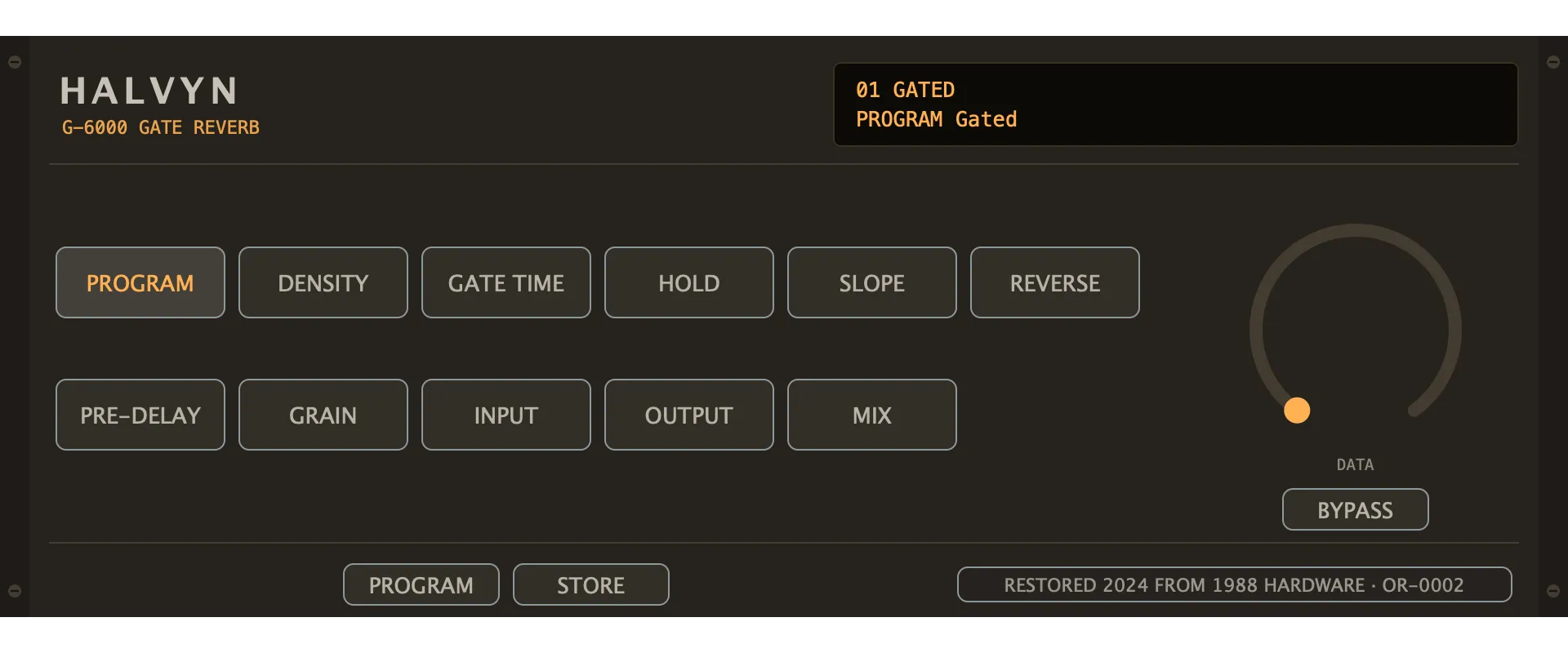
The controls
The controls.
- Program Gated as issued
- Chooses the envelope family that shapes the burst: Gated, a flat burst that cuts off at the gate time; Reverse, a burst that ramps up toward the cut; or Nonlinear, one whose taps scatter inside the window.
- Density 0–100 % · 70 % as issued
- Sets the density of the early-reflection burst that the gate chops off.
- Gate Time 20–500 ms · 180 ms as issued
- Sets how long the burst holds before the gate chops it off, in milliseconds.
- Hold 0–500 ms · 40 ms as issued
- Extends Gate Time, in milliseconds, before the gate begins to close.
- Slope 0–100 % · 20 % as issued
- Sets the steepness of the gate's close, from a hard cut at 0 % to a soft fade at 100 %.
- Reverse Off as issued
- Flips the burst's time-contour end for end — Gated becomes a swell, Reverse becomes a chop — the reverse-reverb effect.
- Pre-delay 0–100 ms · 0 ms as issued
- Sets the silent gap before the early-reflection burst begins, in milliseconds.
- Grain 16-bit as issued
- Chooses the bit depth the gate's delay memory is quantized to: Off, full resolution; 16-bit; or 12-bit, the coarser period grain.
- Input -24.00–24.00 dB · 0.00 dB as issued
- Sets the level going in, in decibels, before the signal reaches the restored circuit.
- Output -24.00–24.00 dB · 0.00 dB as issued
- Sets the level coming out, in decibels, after the restored circuit and the Mix blend.
- Mix 0–100 % · 40 % as issued
- Blends the restored circuit against the untouched signal at equal power, from the untouched signal alone at 0 % to the circuit alone at 100 %.
- Bypass Off as issued
- Takes the restored circuit out of the path and passes the untouched signal, delayed to match the circuit so nothing shifts in time.
A stored setup is a program. PROGRAM hands the DATA wheel to the list, and each program applies as the wheel reaches it; line one shows its number and name, line two ARCHIVE, a pack's name or USER. STORE asks STORE? PRESS AGAIN; a second press opens the name, which starts as USER NN, and line one reads NAME, THEN STORE. The wheel changes the letter, PROGRAM moves on, and STORE stores it; the computer keyboard may type the name instead, Return storing and Escape cancelling. Holding STORE on a user program asks CLEAR? PRESS AGAIN.
Listening
Listening
Demonstration recordings, prepared at the bench.
The gate, plainly
Drums, dry, then the Gated program at 40 % mix. Each hit blooms into a dense burst and is cut off at 180 ms of Gate Time — the tail removed, by design.
0:00 / 0:30
Gate Time, walked
Gate Time opens from 20 to 500 milliseconds across the take. Density goes full, then sparse enough to count the reflections; Slope moves from a hard chop to a soft close.
0:00 / 0:30
The burst, reversed
The Nonlinear program with 12-bit Grain in the delay memory, 60 ms of Pre-delay and a 200 ms Hold. At fifteen seconds Reverse flips the envelope: each burst swells instead of falling.
0:00 / 0:30