OR-0001
Halvyn
United Kingdom · 1983 – c. 2008
Ser. 8000/A047
1991 · effect
Issued as VST3 · AU
Restored 2024 from 1991 hardware.
Halvyn R-8000 — Digital Reverb
Halvyn R-8000 · digital reverb · restored from unit no. 8000/A047 · Halvyn, United Kingdom, 1991
The restorer's note
The unit that began Orrery. This is the reverb our founder rebuilt board by board in 2011, after Halvyn had been gone three years and no one else would — grained, deep, a little metallic in the tail, and on records you already know. It is catalogued OR-0001, and it will never be improved. Everything else here follows from it.
Acquisition
Prices are exclusive of tax. Customers in a country that charges VAT or sales tax will be liable at the rate set by that country; the relevant amount is added at checkout to the purchase price.
The plate
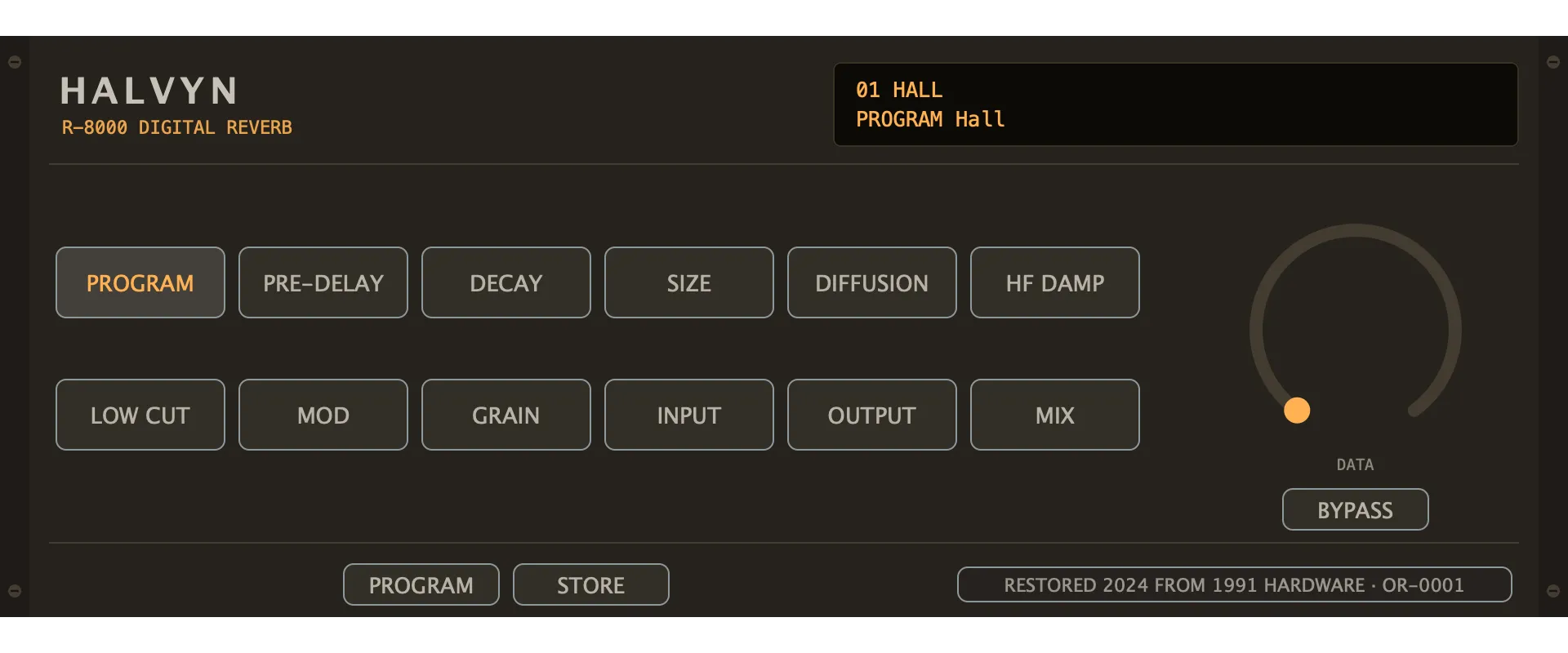
The controls
The controls.
- Program Hall as issued
- Chooses the reverb's space: Hall, Plate, Room, Chamber, or Ambience — each its own delay-network layout and diffusion.
- Pre-Delay 0–200 ms · 20 ms as issued
- Sets the silent gap before the reverb tail begins, in milliseconds.
- Decay (RT60) 0.2–20.0 s · 2.0 s as issued
- Sets the reverb's decay time (RT60), in seconds — how long the tail takes to fade.
- Size 0–100 % · 50 % as issued
- Sets the size of the simulated space, scaling the delay network's lengths.
- Diffusion 0–100 % · 70 % as issued
- Sets the density of the allpass diffusion that smooths the reverb's reflections into a tail.
- HF Damp 1.0–20.0 kHz · 6.0 kHz as issued
- Sets the low-pass filter inside the reverb's feedback path, damping the tail's high frequencies as it decays.
- Low Cut 20–500 Hz · 20 Hz as issued
- Sets the high-pass filter on the signal feeding the reverb, trimming low frequency out of the send.
- Mod 0–100 % · 20 % as issued
- Sets the depth of the slow modulation applied to the reverb tail, there to keep it from ringing on a static pitch.
- Grain 16-bit as issued
- Chooses the bit depth the delay network's memory is quantized to: Off, full resolution; 16-bit; or 12-bit, the coarser period grain.
- Input -24.00–24.00 dB · 0.00 dB as issued
- Sets the level going in, in decibels, before the signal reaches the restored circuit.
- Output -24.00–24.00 dB · 0.00 dB as issued
- Sets the level coming out, in decibels, after the restored circuit and the Mix blend.
- Mix 0–100 % · 30 % as issued
- Blends the restored circuit against the untouched signal at equal power, from the untouched signal alone at 0 % to the circuit alone at 100 %.
- Bypass Off as issued
- Takes the restored circuit out of the path and passes the untouched signal, delayed to match the circuit so nothing shifts in time.
A stored setup is a program. PROGRAM hands the DATA wheel to the list, and each program applies as the wheel reaches it; line one shows its number and name, line two ARCHIVE, a pack's name or USER. STORE asks STORE? PRESS AGAIN; a second press opens the name, which starts as USER NN, and line one reads NAME, THEN STORE. The wheel changes the letter, PROGRAM moves on, and STORE stores it; the computer keyboard may type the name instead, Return storing and Escape cancelling. Holding STORE on a user program asks CLEAR? PRESS AGAIN.
Listening
Listening
Demonstration recordings, prepared at the bench.
The hall, plainly
Sparse percussion, dry, then the Hall program at 35 % mix. Each hit blooms into the tank and is left to finish.
0:00 / 0:30
Decay, opened up
Decay opens from 0.8 to 12 seconds across the take. Diffusion begins sparse enough to count the reflections, then goes dense; Size widens last.
0:00 / 0:30
The plate, pushed
The Plate, pushed to the murky end: 12-bit Grain in the delay memory, Mod at 80 %, HF Damp down to 2 kHz, 120 ms of Pre-Delay.
0:00 / 0:30
The exhibit
The exhibit.
