OR-0007
Halvyn
United Kingdom · 1983 – c. 2008
Ser. 9000/A012
1994 · effect
Issued as VST3 · AU
Restored 2024 from 1994 hardware.
Halvyn R-9000 — Digital Reverb (flagship)
Halvyn R-9000 · digital reverb · restored from unit no. 9000/A012 · Halvyn, United Kingdom, 1994
The restorer's note
The top of the range — denser, deeper, and more editable than the R-8000, the reverb whose programs engineers guarded like recipes. Serial A012, one of the first built. Halvyn held that its DSP was simply better; on the evidence of this unit, it was.
Acquisition
Prices are exclusive of tax. Customers in a country that charges VAT or sales tax will be liable at the rate set by that country; the relevant amount is added at checkout to the purchase price.
The plate
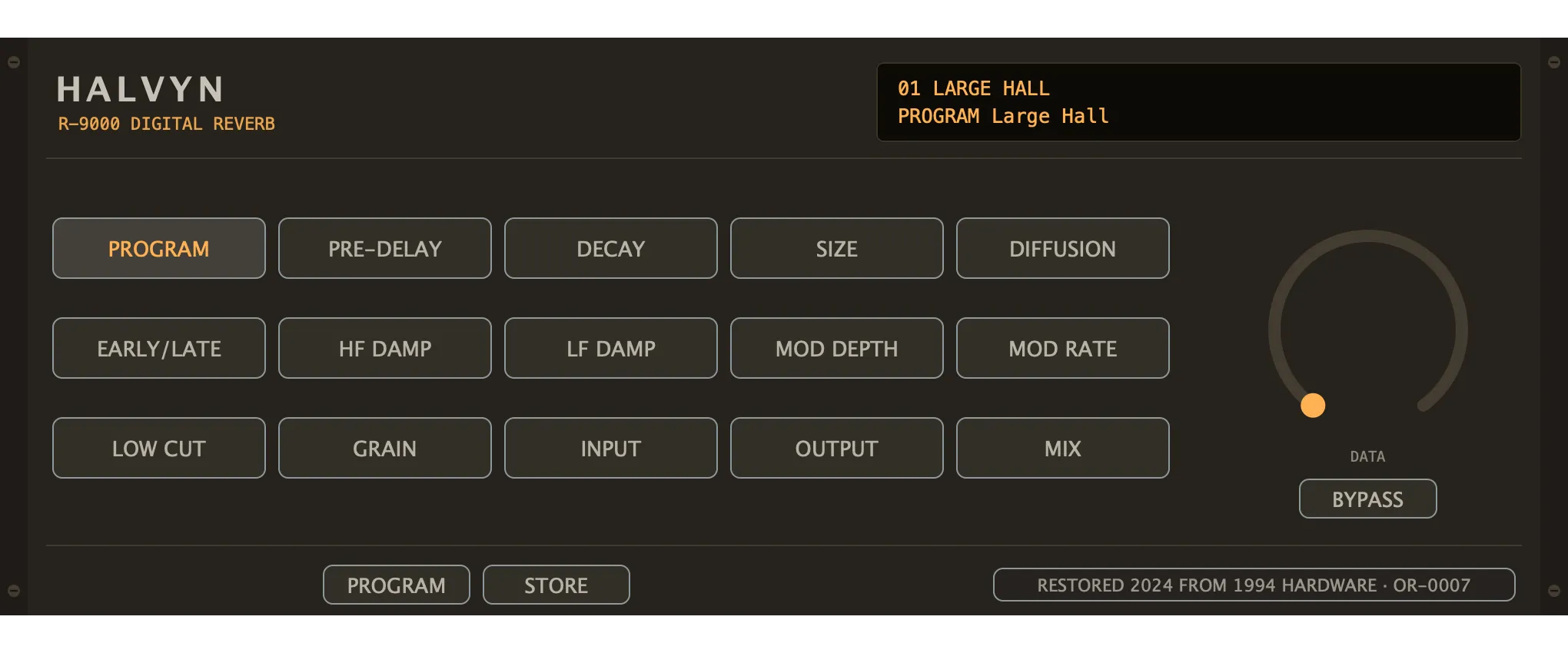
The controls
The controls.
- Program Large Hall as issued
- Chooses the reverb's space: Large Hall, Concert, Cathedral, Plate, Chamber, Room, or Ambience — each its own delay-network layout and scale.
- Pre-Delay 0–500 ms · 24 ms as issued
- Sets the silent gap before the reverb tail begins, in milliseconds.
- Decay (RT60) 0.2–30.0 s · 2.4 s as issued
- Sets the reverb's decay time (RT60), in seconds — how long the tail takes to fade.
- Size 0–100 % · 60 % as issued
- Sets the size of the simulated space, scaling the delay network.
- Diffusion 0–100 % · 75 % as issued
- Sets the density of the allpass diffusion that smooths the reverb's reflections into a tail.
- Early/Late 0–100 % · 50 % as issued
- Balances the early reflections against the late tail, from early reflections alone at 0 % to the tail alone at 100 %.
- HF Damp 1.0–20.0 kHz · 6.0 kHz as issued
- Sets the high-frequency damping inside the reverb's feedback, darkening the tail as it decays.
- LF Damp 0–100 % · 20 % as issued
- Sets how much faster the low frequencies die away than the rest of the tail, from none at 0 % to a sharp cut at 100 %.
- Mod Depth 0–100 % · 25 % as issued
- Sets the depth of the chorusing modulation applied to the reverb tail.
- Mod Rate 0.10–5.00 Hz · 0.80 Hz as issued
- Sets the rate of the chorusing modulation applied to the reverb tail, in Hz.
- Low Cut 20–500 Hz · 20 Hz as issued
- Sets the high-pass filter on the signal feeding the reverb, trimming low frequency out of the send.
- Grain 16-bit as issued
- Chooses the bit depth the tank's delay memory is quantized to: Off, full resolution; 16-bit; or 12-bit, the coarser period grain.
- Input -24.00–24.00 dB · 0.00 dB as issued
- Sets the level going in, in decibels, before the signal reaches the restored circuit.
- Output -24.00–24.00 dB · 0.00 dB as issued
- Sets the level coming out, in decibels, after the restored circuit and the Mix blend.
- Mix 0–100 % · 30 % as issued
- Blends the restored circuit against the untouched signal at equal power, from the untouched signal alone at 0 % to the circuit alone at 100 %.
- Bypass Off as issued
- Takes the restored circuit out of the path and passes the untouched signal, delayed to match the circuit so nothing shifts in time.
A stored setup is a program. PROGRAM hands the DATA wheel to the list, and each program applies as the wheel reaches it; line one shows its number and name, line two ARCHIVE, a pack's name or USER. STORE asks STORE? PRESS AGAIN; a second press opens the name, which starts as USER NN, and line one reads NAME, THEN STORE. The wheel changes the letter, PROGRAM moves on, and STORE stores it; the computer keyboard may type the name instead, Return storing and Escape cancelling. Holding STORE on a user program asks CLEAR? PRESS AGAIN.
Listening
Listening
Demonstration recordings, prepared at the bench.
The cathedral, plainly
Sparse percussion, dry, then the Cathedral program at 35 % mix. Each hit blooms into the flagship tank and is left to finish.
0:00 / 0:30
Early, then late
Early/Late crosses from all reflections to all tail. Diffusion thickens from 35 to 90 %, then Decay (RT60) opens from 1.5 to 30 seconds and Size widens to full.
0:00 / 0:30
The tank, clouded
300 milliseconds of Pre-Delay before a 12-second tail. HF Damp at 3 kHz and LF Damp at 80 % close the room in; Mod Depth at 70 % and Mod Rate at 3 Hz set the tail chorusing; Low Cut holds the send at 150 Hz and the delay memory runs 12-bit Grain.
0:00 / 0:30
Seven programs, in order
The seven programs, four seconds apiece — Large Hall, Concert, Cathedral, Plate, Chamber, Room, Ambience. Same material, same Decay; only the topology changes.
0:00 / 0:30