OR-0028
Salo Oy
Salo, Finland · 1991 – c. 2004
Ser. LN-9207-0033
1992 · effect
Issued as VST3 · AU
Restored 2025 from 1992 hardware.
Salo 2110 — POTS Telephone
Salo 2110 · analog line reference · restored from unit no. LN-9207-0033 · Salo Oy, Salo, Finland, 1992
The restorer's note
The oldest voice in the house and the one everyone recognizes — narrowband, companded, a dial tone somewhere in its bones. Serial 0033: an early unit, built the year after Salo opened its doors. The µ-law companding is original; a plain equaliser would only impersonate it.
Acquisition
Prices are exclusive of tax. Customers in a country that charges VAT or sales tax will be liable at the rate set by that country; the relevant amount is added at checkout to the purchase price.
The plate
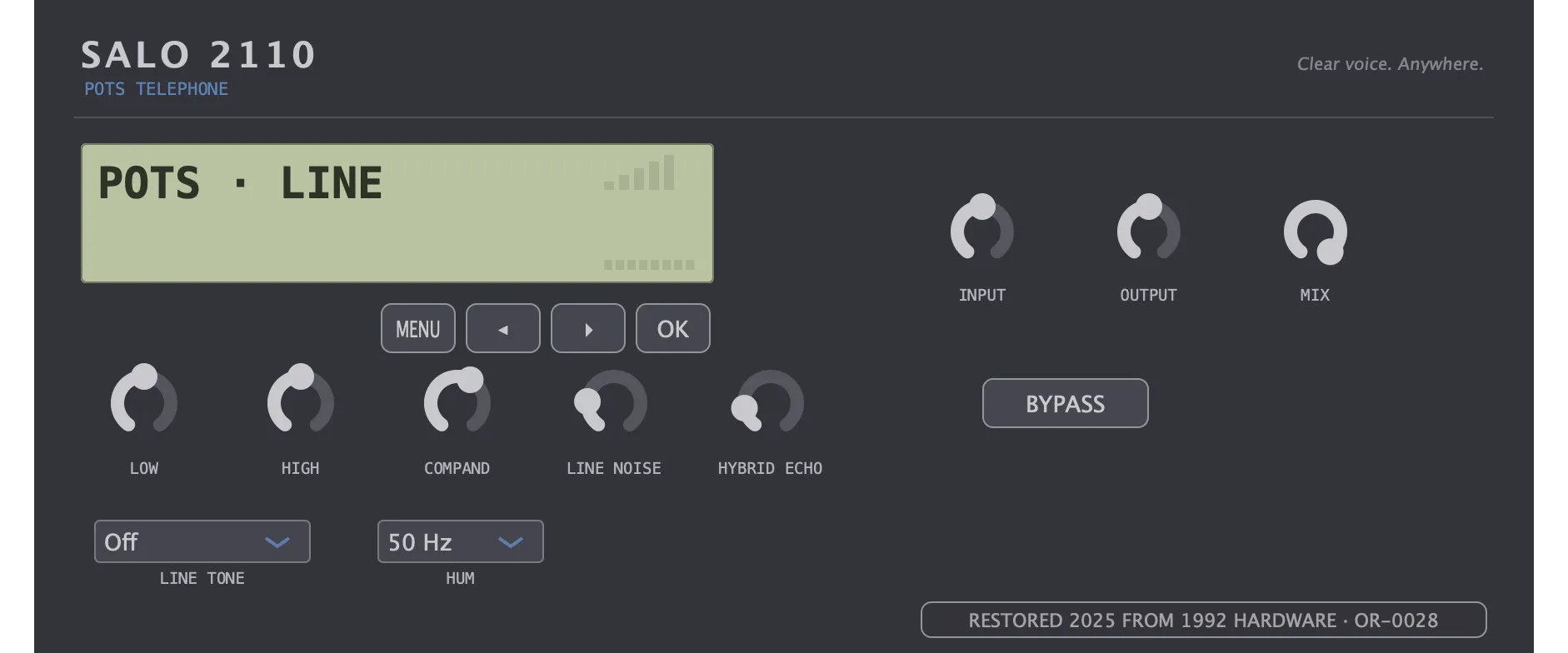
The controls
The controls.
- Low 200–600 Hz · 300 Hz as issued
- Sets the high-pass corner of the line's narrow telephone band.
- High 2.4–4.0 kHz · 3.4 kHz as issued
- Sets the low-pass corner of the line's narrow telephone band.
- Compand 0–100 % · 60 % as issued
- Sets the depth of the µ-law companding crunch that gives the line its voice.
- Line Noise 0–100 % · 20 % as issued
- Adds hiss and mains hum to the line; HUM sets the hum's frequency.
- Hybrid Echo 0–100 % · 15 % as issued
- Adds the two-wire hybrid's echo — the reflection that makes a telephone line sound like it's in a room.
- Line Tone Off as issued
- Adds a call-progress tone to the line: Off, Dial, Ringback, or Busy.
- Hum 50 Hz as issued
- Chooses the mains frequency of the hum under Line Noise: 50 Hz, as across Europe, or 60 Hz, as across North America.
- Input -24.00–24.00 dB · 0.00 dB as issued
- Sets the level going in, in decibels, before the signal reaches the restored circuit.
- Output -24.00–24.00 dB · 0.00 dB as issued
- Sets the level coming out, in decibels, after the restored circuit and the Mix blend.
- Mix 0–100 % · 100 % as issued
- Blends the restored circuit against the untouched signal at equal power, from the untouched signal alone at 0 % to the circuit alone at 100 %.
- Bypass Off as issued
- Takes the restored circuit out of the path and passes the untouched signal, delayed to match the circuit so nothing shifts in time.
A stored setup is a memory. MENU opens the list: the display reads MEMORY 03/12, with the memory's name below. ◂ ▸ step through it without changing the sound, and OK loads the one shown. Holding OK asks STORE? OK; OK again opens the name, which starts as USER NN. ◂ ▸ change the letter, OK moves on, and holding OK stores it; the computer keyboard may type the name instead, Return storing and Escape cancelling. Holding MENU on a user memory asks CLEAR? OK.
Listening
Listening
Demonstration recordings, prepared at the bench.
The local line
The note reads dry for six seconds; then the line takes it — 300 Hz to 3.4 kHz, the companding crunch at its bench 60 % — and the voice arrives as a call.
0:00 / 0:30
The band, closing
Low climbs from 200 to 600 Hz while High falls from 4 kHz to 2.4 kHz — the band closing on the voice from both ends — and Compand then brings the µ-law crunch from nought to full.
0:00 / 0:30
On hold
The mix is sent down the line: the Dial tone opens the call, Line Noise at 70 % and Hybrid Echo at 60 % colour the passage — the music of a phone left off the hook — and the Busy signal ends it.
0:00 / 0:30