OR-0029
Salo Oy
Salo, Finland · 1991 – c. 2004
Ser. RG-9312-0245
1993 · instrument
Issued as VST3 · AU
Restored 2025 from 1993 hardware.
Salo 3210 — Monophonic Ringer
Salo 3210 · single-voice ringer module · restored from unit no. RG-9312-0245 · Salo Oy, Salo, Finland, 1993
The restorer's note
One voice, one buzzer, one melody — a phone ringing in a coat pocket in 1993. There is nothing to improve here, and we have improved nothing; the tinniness is the piezo speaker, modeled faithfully from the module as found.
Acquisition
Prices are exclusive of tax. Customers in a country that charges VAT or sales tax will be liable at the rate set by that country; the relevant amount is added at checkout to the purchase price.
Issue 1.1.0
From this issue, a studio that sends its bypass to the instrument works the BYPASS key on the plate: one switch, and the key lights. Earlier issues kept the two apart. A studio that switches the instrument off its own way still does so, and BYPASS stays as it is. A session saved with an earlier issue that moved the studio's bypass over time does not carry those movements into 1.1.0; write them again on BYPASS. Everything else in the session loads as saved.
The plate
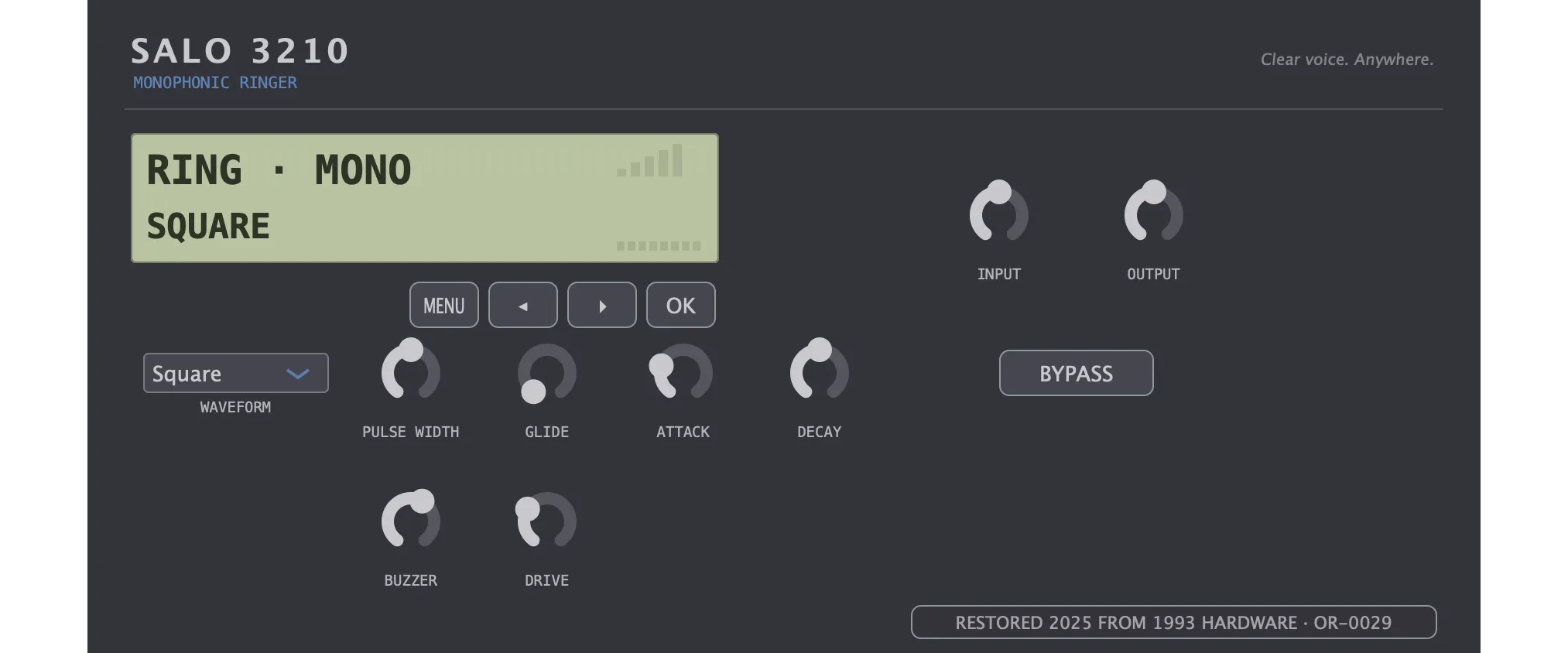
The controls
The controls.
- Waveform Square as issued
- Sets the oscillator's shape: Square, Pulse, or Triangle.
- Pulse Width 5–95 % · 50 % as issued
- Sets the duty cycle of the Pulse waveform; it has no effect on Square or Triangle.
- Glide 0–120 ms · 0 ms as issued
- Sets the portamento time between notes.
- Attack 0.0–50.0 ms · 2.0 ms as issued
- Sets how quickly a note reaches full volume after a key is struck.
- Decay 20–2000 ms · 400 ms as issued
- Sets how long a note rings before falling silent.
- Buzzer 0–100 % · 60 % as issued
- Sets the piezo buzzer's resonance and coloration — the tinniness of the ring.
- Drive 0–100 % · 30 % as issued
- Sets how hard the note is clipped into the buzzer's resonance.
- Input -24.00–24.00 dB · 0.00 dB as issued
- Sets the level going in, in decibels, before the signal reaches the restored circuit.
- Output -24.00–24.00 dB · 0.00 dB as issued
- Sets the level coming out, in decibels, after the restored circuit and the Mix blend.
- Bypass Off as issued
- Silences the ringer entirely; with no incoming signal to fall back to, Bypass here mutes rather than passes anything through.
A stored setup is a memory. MENU opens the list: the display reads MEMORY 03/12, with the memory's name below. ◂ ▸ step through it without changing the sound, and OK loads the one shown. Holding OK asks STORE? OK; OK again opens the name, which starts as USER NN. ◂ ▸ change the letter, OK moves on, and holding OK stores it; the computer keyboard may type the name instead, Return storing and Escape cancelling. Holding MENU on a user memory asks CLEAR? OK.
Listening
Listening
Demonstration recordings, prepared at the bench.
The ring, plainly
A monophonic ringing phrase at bench settings — the Square wave through the piezo-buzzer model, Buzzer at 60 % — repeated, as the machine insists.
0:00 / 0:30
Three shapes and a slide
The same phrase through Square, then Pulse — Pulse Width swept from 5 to 95 % — then Triangle; Glide at 80 ms lets the final phrase slide between its notes.
0:00 / 0:30
The buzzer, in and out
Drive at 90 % clips the wave hard while Buzzer walks from nought to full — the plastic resonance arriving — then drops away and returns for the close. Attack at 10 ms, Decay at 800 ms.
0:00 / 0:30