OR-0023
Salo Oy
Salo, Finland · 1991 – c. 2004
Ser. CU-9426-0173
1994 · effect
Issued as VST3 · AU
Restored 2025 from 1994 hardware.
Salo 3310 — Full-Rate GSM Codec
Salo 3310 · Full-Rate voice codec · restored from unit no. CU-9426-0173 · Salo Oy, Salo, Finland, 1994
The restorer's note
This is the voice of a 1994 mobile call — the codec that made distance vanish and, in the same stroke, gave it that half-swallowed, faintly underwater grain. The restored unit came off a decommissioned Nordic carrier's test bench, its panel still tacky with a shift sticker. The watery quality is the RPE-LTP algorithm working exactly as designed. We have not clarified it; clarity was never the assignment.
Acquisition
Prices are exclusive of tax. Customers in a country that charges VAT or sales tax will be liable at the rate set by that country; the relevant amount is added at checkout to the purchase price.
The plate
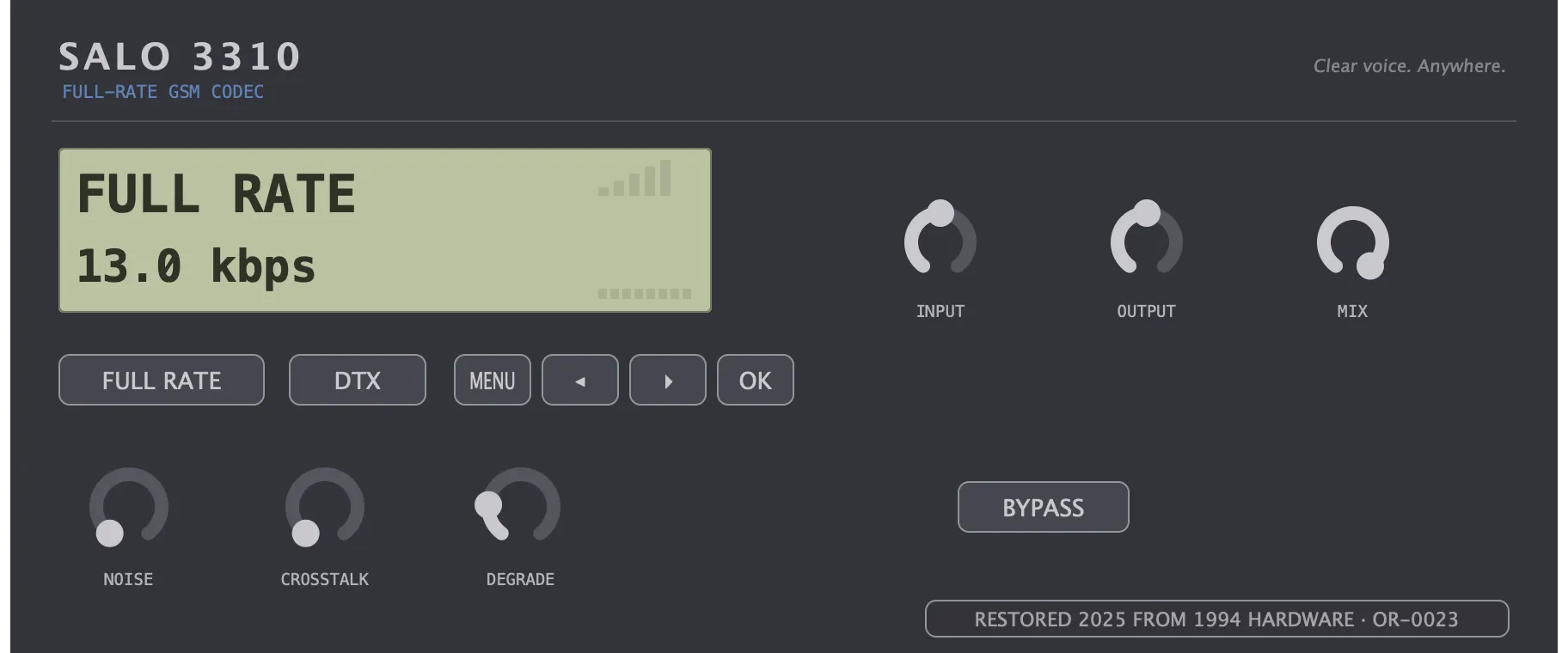
The controls
The controls.
- Rate Full as issued
- Chooses the coding that carries the call: Full, GSM's original full-rate codec, or Half, its coarser half-rate successor.
- Noise 0–100 % · 0 % as issued
- Adds handset and background noise to the signal before the codec encodes it.
- Crosstalk 0–100 % · 0 % as issued
- Adds bleed from a neighbouring channel into the voice, after the codec has decoded it.
- Degrade 0–100 % · 20 % as issued
- Runs the voice through the codec up to eight times over, and strains its companding. At 0 % the call is as the network carried it; at 100 % it has been forwarded too many times.
- DTX Off as issued
- Detects silence in the call and substitutes synthetic comfort noise for the gap, as the network's voice-activity detector did.
- Input -24.00–24.00 dB · 0.00 dB as issued
- Sets the level going in, in decibels, before the signal reaches the restored circuit.
- Output -24.00–24.00 dB · 0.00 dB as issued
- Sets the level coming out, in decibels, after the restored circuit and the Mix blend.
- Mix 0–100 % · 100 % as issued
- Blends the restored circuit against the untouched signal at equal power, from the untouched signal alone at 0 % to the circuit alone at 100 %.
- Bypass Off as issued
- Takes the restored circuit out of the path and passes the untouched signal, delayed to match the circuit so nothing shifts in time.
A stored setup is a memory. MENU opens the list: the display reads MEMORY 03/12, with the memory's name below. ◂ ▸ step through it without changing the sound, and OK loads the one shown. Holding OK asks STORE? OK; OK again opens the name, which starts as USER NN. ◂ ▸ change the letter, OK moves on, and holding OK stores it; the computer keyboard may type the name instead, Return storing and Escape cancelling. Holding MENU on a user memory asks CLEAR? OK.
Listening
Listening
Demonstration recordings, prepared at the bench.
The call, filtered
The note is read dry for six seconds; the full-rate codec then takes the line. What arrives is the 1994 call — half-swallowed, faintly underwater, exactly as designed.
0:00 / 0:30
Eight generations down
Degrade is walked from nought to full — one encode generation stacking toward eight — and at twenty-four seconds Rate drops to Half. Distance accumulates.
0:00 / 0:30
A bad line
A bad line, assembled deliberately: Half rate, handset Noise, adjacent-channel Crosstalk, and DTX swapping each pause for comfort noise.
0:00 / 0:30
The exhibit
The exhibit.
