OR-0030
Salo Oy
Salo, Finland · 1991 – c. 2004
Ser. RG-9948-1130
1999 · instrument
Issued as VST3 · AU
Restored 2025 from 1999 hardware.
Salo 3510 — Polyphonic Ringtone
Salo 3510 · polyphonic ringer module · restored from unit no. RG-9948-1130 · Salo Oy, Salo, Finland, 1999
The restorer's note
Six years past the 3210: a handful of cheap FM voices and a marginally better speaker — the brief, beloved age of the polyphonic ringtone. Restored from a late unit. The small-speaker rasp is in the recording, not a fault in yours.
Acquisition
Prices are exclusive of tax. Customers in a country that charges VAT or sales tax will be liable at the rate set by that country; the relevant amount is added at checkout to the purchase price.
Issue 1.1.0
From this issue, a studio that sends its bypass to the instrument works the BYPASS key on the plate: one switch, and the key lights. Earlier issues kept the two apart. A studio that switches the instrument off its own way still does so, and BYPASS stays as it is. A session saved with an earlier issue that moved the studio's bypass over time does not carry those movements into 1.1.0; write them again on BYPASS. Everything else in the session loads as saved.
The plate
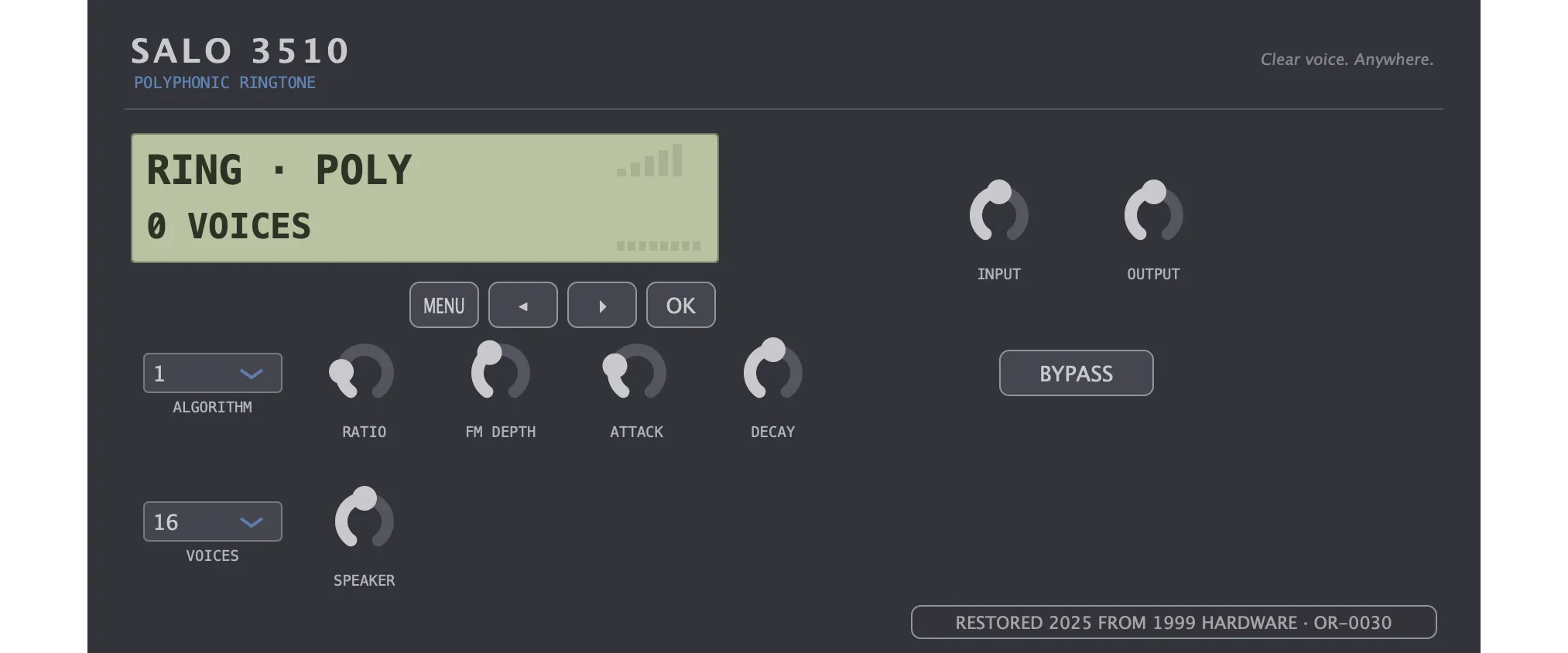
The controls
The controls.
- Algorithm 1 as issued
- Chooses the operator routing for the FM voice: 1, 2, 3, or 4.
- Ratio 0.5–8.0 · 2.0 as issued
- Sets the modulator-to-carrier frequency ratio of the FM voice.
- FM Depth 0–100 % · 40 % as issued
- Sets the FM modulation index — how strongly the modulator colours the tone.
- Attack 0–500 ms · 5 ms as issued
- Sets how quickly each note reaches full volume.
- Decay 20–2000 ms · 600 ms as issued
- Sets how long each note rings before falling silent.
- Speaker 0–100 % · 50 % as issued
- Sets the small-speaker band-limiting and rasp applied to the voice.
- Voices 16 as issued
- Caps the polyphony at 4, 8, 16, or 32 voices.
- Input -24.00–24.00 dB · 0.00 dB as issued
- Sets the level going in, in decibels, before the signal reaches the restored circuit.
- Output -24.00–24.00 dB · 0.00 dB as issued
- Sets the level coming out, in decibels, after the restored circuit and the Mix blend.
- Bypass Off as issued
- Silences the ringtone entirely; with no incoming signal to fall back to, Bypass here mutes rather than passes anything through.
A stored setup is a memory. MENU opens the list: the display reads MEMORY 03/12, with the memory's name below. ◂ ▸ step through it without changing the sound, and OK loads the one shown. Holding OK asks STORE? OK; OK again opens the name, which starts as USER NN. ◂ ▸ change the letter, OK moves on, and holding OK stores it; the computer keyboard may type the name instead, Return storing and Escape cancelling. Holding MENU on a user memory asks CLEAR? OK.
Listening
Listening
Demonstration recordings, prepared at the bench.
Sixteen voices
A chord cycle in A minor with a melody above — the FM voices at bench settings, Algorithm 1, the small speaker doing what it can.
0:00 / 0:30
Four algorithms
Algorithm steps from 1 through 4 as FM Depth rises from 20 to 70 % — the same chords recast four ways — and at the close Ratio jumps to 5.0 and the voicing goes to bells.
0:00 / 0:30
Four voices, then thirty-two
Eight-note chords against a four-voice cap — the earlier notes stolen mid-ring — then Voices is raised to thirty-two and the same chords hold whole. Speaker at full.
0:00 / 0:30