OR-0025
Salo Oy
Salo, Finland · 1991 – c. 2004
Ser. ER-9611-0623
1996 · effect
Issued as VST3 · AU
Restored 2025 from 1996 hardware.
Salo 5110 — Frame Erasure / Dropped Call
Salo 5110 · frame-erasure test unit · restored from unit no. ER-9611-0623 · Salo Oy, Salo, Finland, 1996
The restorer's note
A call dies in stages — a robotic freeze, an underwater warble, then nothing — and this is the unit that let engineers hear each stage on demand. What sounds like failure is the concealment algorithm doing its careful best with frames that never arrived. Preserved intact, silence and all.
Acquisition
Prices are exclusive of tax. Customers in a country that charges VAT or sales tax will be liable at the rate set by that country; the relevant amount is added at checkout to the purchase price.
The plate
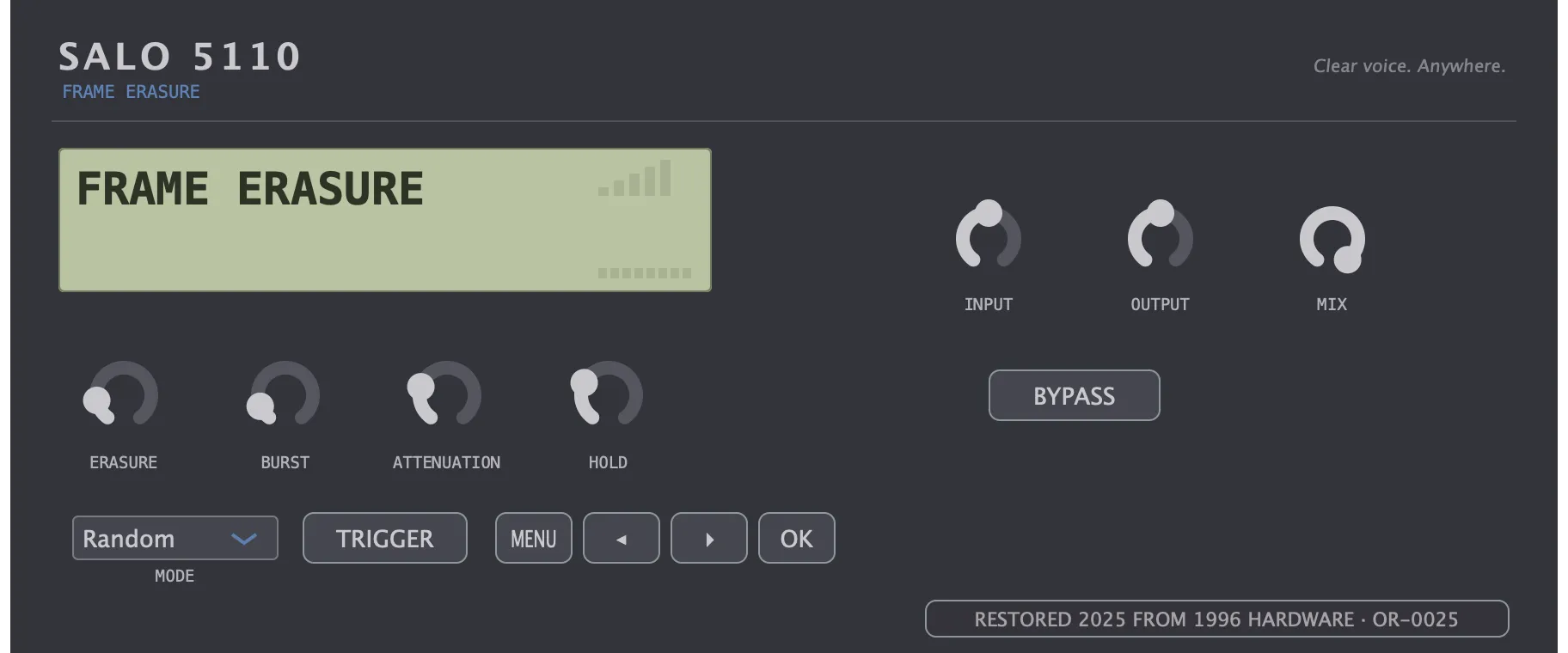
The controls
The controls.
- Mode Random as issued
- Chooses what drives the frame loss: Random probability, a Manual trigger, or an Envelope that degrades call quality over time.
- Erasure 0–100 % · 15 % as issued
- Sets the probability that a frame is lost, in Random and Envelope mode.
- Burst 1–20 frames · 3 frames as issued
- Sets how many consecutive frames are lost per dropout — the length of the freeze.
- Attenuation 0.0–12.0 dB/frame · 3.0 dB/frame as issued
- Sets how quickly the repeated frame fades, in decibels per frame, while the call is frozen.
- Hold 1–40 frames · 12 frames as issued
- Sets how many frames pass before the call mutes completely.
- Trigger Off as issued
- Forces a dropout on demand, for Manual mode or a live performance.
- Input -24.00–24.00 dB · 0.00 dB as issued
- Sets the level going in, in decibels, before the signal reaches the restored circuit.
- Output -24.00–24.00 dB · 0.00 dB as issued
- Sets the level coming out, in decibels, after the restored circuit and the Mix blend.
- Mix 0–100 % · 100 % as issued
- Blends the restored circuit against the untouched signal at equal power, from the untouched signal alone at 0 % to the circuit alone at 100 %.
- Bypass Off as issued
- Takes the restored circuit out of the path and passes the untouched signal, delayed to match the circuit so nothing shifts in time.
A stored setup is a memory. MENU opens the list: the display reads MEMORY 03/12, with the memory's name below. ◂ ▸ step through it without changing the sound, and OK loads the one shown. Holding OK asks STORE? OK; OK again opens the name, which starts as USER NN. ◂ ▸ change the letter, OK moves on, and holding OK stores it; the computer keyboard may type the name instead, Return storing and Escape cancelling. Holding MENU on a user memory asks CLEAR? OK.
Listening
Listening
Demonstration recordings, prepared at the bench.
A weak cell
The note reads plainly for six seconds; then the concealment begins — Erasure at its bench 15 %, each lost frame patched with a repeat of the last good one, fading at 3 dB a frame.
0:00 / 0:30
More and more missing
Erasure is walked from nought to sixty percent — the repeats and freezes thickening as the frames go — and at twenty-four seconds Burst rises to ten frames, so each loss holds longer.
0:00 / 0:30
Dropped by hand
Mode set to Manual: each dropout is forced with Trigger, first sparingly, then in a closing run — Burst raised to twelve frames, Attenuation at 6 dB a frame, Hold at six, so each long dropout fades and then goes to nothing.
0:00 / 0:30