OR-0026
Salo Oy
Salo, Finland · 1991 – c. 2004
Ser. RC-9932-0071
1999 · effect
Issued as VST3 · AU
Restored 2025 from 1999 hardware.
Salo 6150 — Adaptive Rate (AMR)
Salo 6150 · adaptive multi-rate reference · restored from unit no. RC-9932-0071 · Salo Oy, Salo, Finland, 1999
The restorer's note
One control, marked in signal bars: the sound of walking out of coverage, the voice coarsening and robotizing as the network drops to a lower rate. This was Salo's last major design before the group was wound down. The archive holds one of the final units to leave the bench.
Acquisition
Prices are exclusive of tax. Customers in a country that charges VAT or sales tax will be liable at the rate set by that country; the relevant amount is added at checkout to the purchase price.
The plate
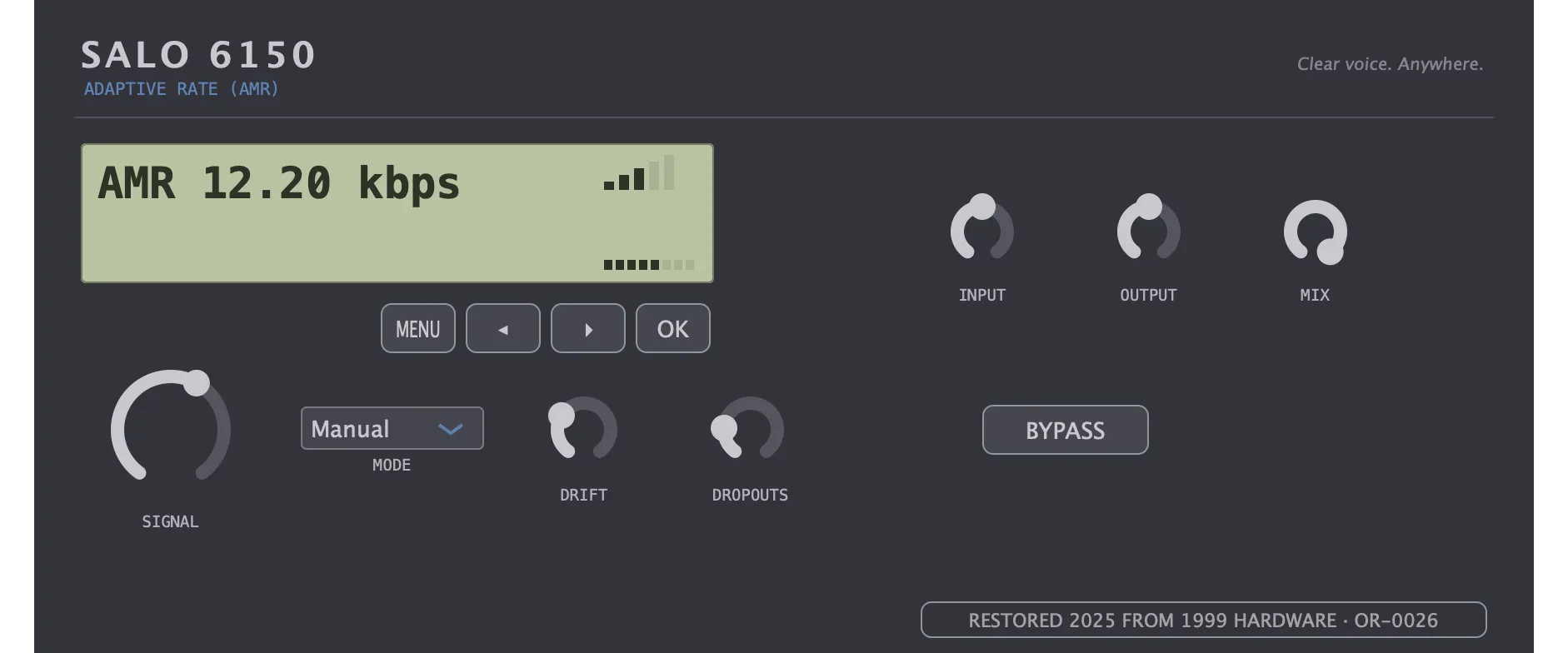
The controls
The controls.
- Signal 0–100 % · 60 % as issued
- Sets the signal strength, shown in bars, that selects the AMR encoding rate from 4.75 to 12.2 kbps — low bars, a coarser call.
- Mode Manual as issued
- Chooses whether the signal bars drift on their own, in Auto, or stay where set, in Manual.
- Drift 0–100 % · 30 % as issued
- Sets how much the signal bars wander on their own, in Auto mode.
- Dropouts 0–100 % · 20 % as issued
- Sets how strongly a weak signal triggers lost frames.
- Input -24.00–24.00 dB · 0.00 dB as issued
- Sets the level going in, in decibels, before the signal reaches the restored circuit.
- Output -24.00–24.00 dB · 0.00 dB as issued
- Sets the level coming out, in decibels, after the restored circuit and the Mix blend.
- Mix 0–100 % · 100 % as issued
- Blends the restored circuit against the untouched signal at equal power, from the untouched signal alone at 0 % to the circuit alone at 100 %.
- Bypass Off as issued
- Takes the restored circuit out of the path and passes the untouched signal, delayed to match the circuit so nothing shifts in time.
A stored setup is a memory. MENU opens the list: the display reads MEMORY 03/12, with the memory's name below. ◂ ▸ step through it without changing the sound, and OK loads the one shown. Holding OK asks STORE? OK; OK again opens the name, which starts as USER NN. ◂ ▸ change the letter, OK moves on, and holding OK stores it; the computer keyboard may type the name instead, Return storing and Escape cancelling. Holding MENU on a user memory asks CLEAR? OK.
Listening
Listening
Demonstration recordings, prepared at the bench.
Three bars
The note reads dry for six seconds; then the codec takes the line at bench settings — Signal at 60 %, three bars, Mode held Manual — the rate ladder sitting mid-table.
0:00 / 0:30
Walking out of coverage
Signal is walked from five bars to none over the length of the note. The codec steps down its ladder as the bars fall, the voice coarsening rate by rate; near nothing, the frame losses begin.
0:00 / 0:30
The signal wanders
Mode set to Auto with Drift at 80 %: the bars wander on their own around a low Signal, the rate climbing and falling with them, and with Dropouts at 60 % the losses come and go where the signal thins.
0:00 / 0:30