OR-0032
Salo Oy
Salo, Finland · 1991 – c. 2004
Ser. VX-9640-0088
1996 · effect
Issued as VST3 · AU
Restored 2025 from 1996 hardware.
Salo 6210 — Vocoder
Salo 6210 · analysis/synthesis voice processor · restored from unit no. VX-9640-0088 · Salo Oy, Salo, Finland, 1996
The restorer's note
The robot voice, from the company that already owned the mathematics of speech. Salo built it for secure comms; musicians would have loved it, had they ever been let near one. Serial 0088 — an early, low-numbered unit, restored with its bands untouched.
Acquisition
Prices are exclusive of tax. Customers in a country that charges VAT or sales tax will be liable at the rate set by that country; the relevant amount is added at checkout to the purchase price.
The plate
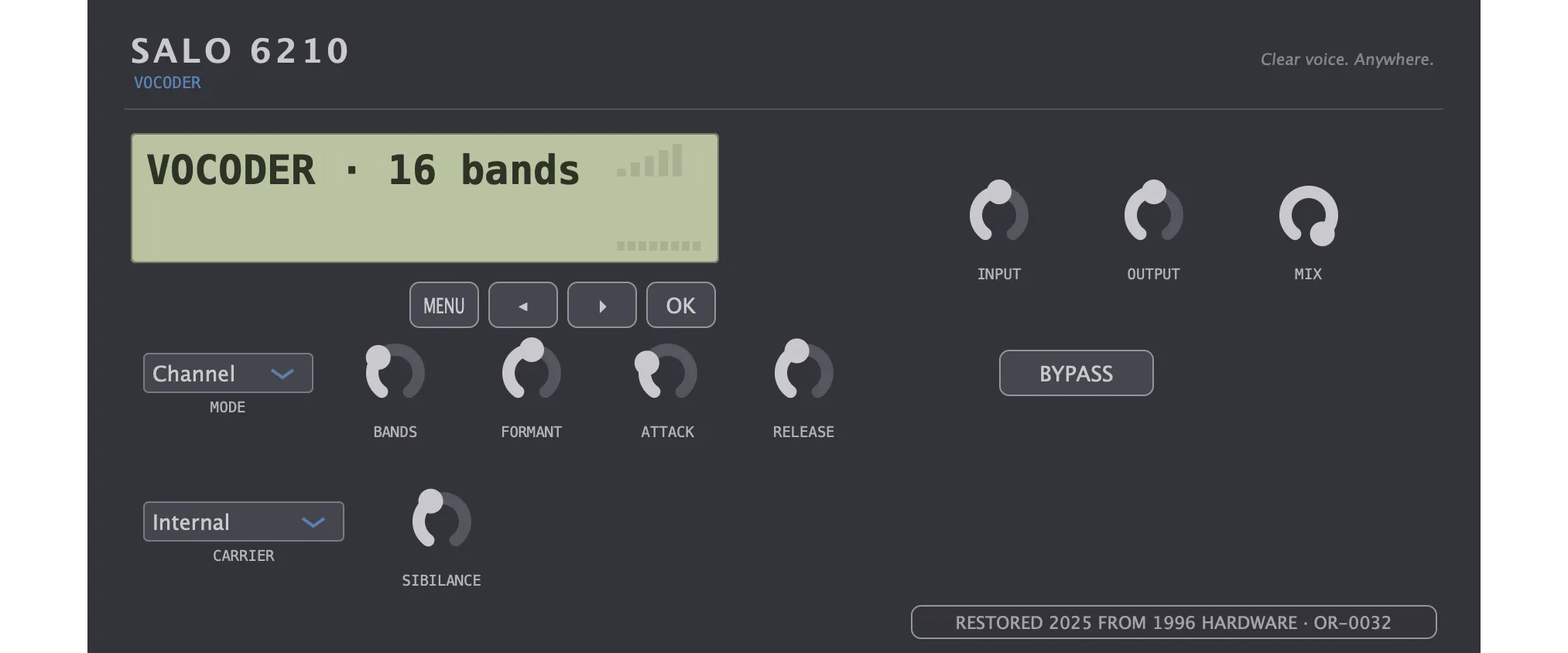
The controls
The controls.
- Mode Channel as issued
- Chooses the vocoding method: Channel, a bank of band filters, or LPC, the linear-predictive core.
- Bands 8–32 · 16 as issued
- Sets the number of analysis bands, from 8 to 32 — more bands, clearer speech.
- Carrier Internal as issued
- Chooses the excitation source the vocoder sings through: Internal, which follows the note played; Sidechain; or Noise.
- Formant -12.0–12.0 st · 0.0 st as issued
- Shifts the centre frequencies of the vocoder's bands, in semitones.
- Attack 0–100 ms · 5 ms as issued
- Sets the envelope follower's attack — how quickly it tracks a rising level, and how much it smears.
- Release 1–500 ms · 40 ms as issued
- Sets the envelope follower's release, after the level falls.
- Sibilance 0–100 % · 40 % as issued
- Lets unvoiced, high-frequency consonants pass straight through, for intelligibility.
- Input -24.00–24.00 dB · 0.00 dB as issued
- Sets the level going in, in decibels, before the signal reaches the restored circuit.
- Output -24.00–24.00 dB · 0.00 dB as issued
- Sets the level coming out, in decibels, after the restored circuit and the Mix blend.
- Mix 0–100 % · 100 % as issued
- Blends the restored circuit against the untouched signal at equal power, from the untouched signal alone at 0 % to the circuit alone at 100 %.
- Bypass Off as issued
- Takes the restored circuit out of the path and passes the untouched signal, delayed to match the circuit so nothing shifts in time.
A stored setup is a memory. MENU opens the list: the display reads MEMORY 03/12, with the memory's name below. ◂ ▸ step through it without changing the sound, and OK loads the one shown. Holding OK asks STORE? OK; OK again opens the name, which starts as USER NN. ◂ ▸ change the letter, OK moves on, and holding OK stores it; the computer keyboard may type the name instead, Return storing and Escape cancelling. Holding MENU on a user memory asks CLEAR? OK.
Listening
Listening
Demonstration recordings, prepared at the bench.
The voice, played
The note reads dry for six seconds; then the Internal carrier takes it — a held line sung by the filterbank, sixteen Bands wide — and the reading becomes the machine's.
0:00 / 0:30
Eight bands to thirty-two
Bands step from eight — barely words — to sixteen, then thirty-two, the reading sharpening at each move: the resolution of the filterbank, heard arriving. Mode then switches to LPC, and the same voice is carried by the all-pole model instead.
0:00 / 0:30
Spoken through the pad
Carrier switched to Sidechain: the pad is made to speak. Sibilance rises to 80 % and the consonants return; Formant is pushed up seven semitones, then down; Attack and Release open at the close and the words smear.
0:00 / 0:30