OR-0033
Salo Oy
Salo, Finland · 1991 – c. 2004
Ser. HF-9922-0261
1999 · effect
Issued as VST3 · AU
Restored 2025 from 1999 hardware.
Salo 6310 — Speakerphone
Salo 6310 · half-duplex hands-free unit · restored from unit no. HF-9922-0261 · Salo Oy, Salo, Finland, 1999
The restorer's note
The exact texture of a 90s conference call — the pumping echo-canceller, and the way whoever spoke quieter simply got clipped out. That switching is not something we missed; it is the half-duplex design, and it is the whole character.
Acquisition
Prices are exclusive of tax. Customers in a country that charges VAT or sales tax will be liable at the rate set by that country; the relevant amount is added at checkout to the purchase price.
The plate
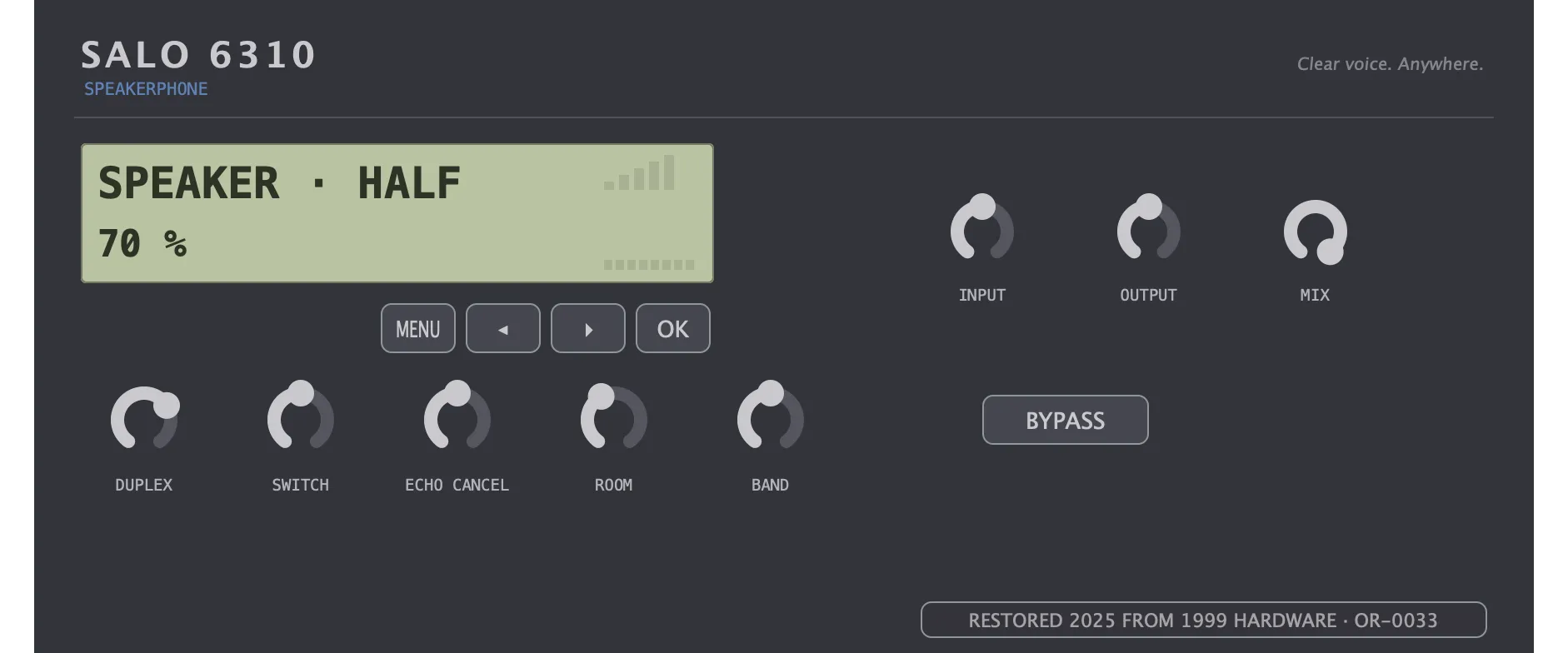
The controls
The controls.
- Duplex 0–100 % · 70 % as issued
- Sets how aggressively the speakerphone clips out whoever isn't the active talker, from full duplex at 0 % to hard half-duplex switching at 100 %.
- Switch 5–200 ms · 40 ms as issued
- Sets how quickly the half-duplex switch ducks the line — the speed behind its pumping.
- Echo Cancel 0–100 % · 50 % as issued
- Sets the echo canceller's strength, trading an uncancelled residual at low settings for an over-suppression pump at high ones.
- Room 0–100 % · 40 % as issued
- Sets the box-like comb resonance of the speakerphone's enclosure.
- Band 2.5–5.0 kHz · 3.5 kHz as issued
- Sets the speakerphone's bandwidth — the low-pass corner that narrows the voice.
- Input -24.00–24.00 dB · 0.00 dB as issued
- Sets the level going in, in decibels, before the signal reaches the restored circuit.
- Output -24.00–24.00 dB · 0.00 dB as issued
- Sets the level coming out, in decibels, after the restored circuit and the Mix blend.
- Mix 0–100 % · 100 % as issued
- Blends the restored circuit against the untouched signal at equal power, from the untouched signal alone at 0 % to the circuit alone at 100 %.
- Bypass Off as issued
- Takes the restored circuit out of the path and passes the untouched signal, delayed to match the circuit so nothing shifts in time.
A stored setup is a memory. MENU opens the list: the display reads MEMORY 03/12, with the memory's name below. ◂ ▸ step through it without changing the sound, and OK loads the one shown. Holding OK asks STORE? OK; OK again opens the name, which starts as USER NN. ◂ ▸ change the letter, OK moves on, and holding OK stores it; the computer keyboard may type the name instead, Return storing and Escape cancelling. Holding MENU on a user memory asks CLEAR? OK.
Listening
Listening
Demonstration recordings, prepared at the bench.
The floor, held
Dry for six seconds; then the box takes over at bench settings — band-limited and boxy, the far-end feed ducking the near voice as the unit decides who may speak.
0:00 / 0:30
One voice at a time
Duplex walks from full — both parties audible — to hard half-duplex, one voice at a time; Switch then slows from 5 to 200 milliseconds and the handover becomes a pump.
0:00 / 0:30
The box itself
Room at 90 % and Band down to 2.5 kHz — the enclosure at its worst. Echo Cancel steps to full at ten seconds, scrubbing the reflection and pumping as it works, then falls away again.
0:00 / 0:30