OR-0027
Salo Oy
Salo, Finland · 1991 – c. 2004
Ser. CN-9709-0512
1997 · effect
Issued as VST3 · AU
Restored 2025 from 1997 hardware.
Salo 8110 — Comfort Noise (DTX)
Salo 8110 · discontinuous-transmission reference · restored from unit no. CN-9709-0512 · Salo Oy, Salo, Finland, 1997
The restorer's note
The eeriest thing Salo made. When you stop speaking, your room does not remain — it is quietly swapped for a synthetic hiss that refreshes only now and then, so the silence itself seems to breathe and freeze. Unsettling by accident, and left exactly so.
Acquisition
Prices are exclusive of tax. Customers in a country that charges VAT or sales tax will be liable at the rate set by that country; the relevant amount is added at checkout to the purchase price.
The plate
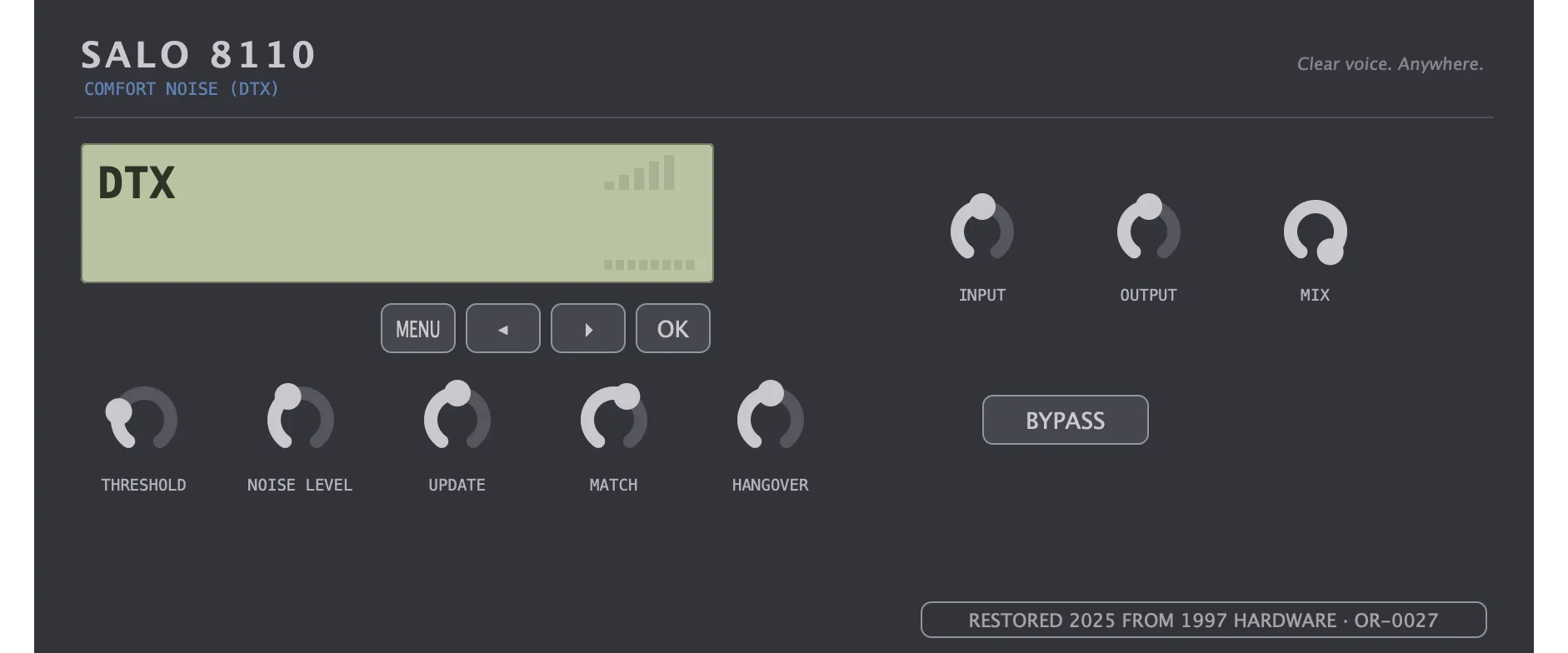
The controls
The controls.
- Threshold -60.0–0.0 dB · -45.0 dB as issued
- Sets the level below which speech is treated as silence and comfort noise takes over, in decibels.
- Noise Level 0–100 % · 40 % as issued
- Sets the loudness of the comfort noise that fills the silence.
- Update 50–2000 ms · 480 ms as issued
- Sets how often the comfort noise is refreshed — the interval behind its stepping, freezing character.
- Match 0–100 % · 60 % as issued
- Sets how closely the comfort noise matches the room's own spectrum, from generic hiss at 0 % to a close match at 100 %.
- Hangover 0–500 ms · 120 ms as issued
- Sets how long speech must be absent before comfort noise takes over.
- Input -24.00–24.00 dB · 0.00 dB as issued
- Sets the level going in, in decibels, before the signal reaches the restored circuit.
- Output -24.00–24.00 dB · 0.00 dB as issued
- Sets the level coming out, in decibels, after the restored circuit and the Mix blend.
- Mix 0–100 % · 100 % as issued
- Blends the restored circuit against the untouched signal at equal power, from the untouched signal alone at 0 % to the circuit alone at 100 %.
- Bypass Off as issued
- Takes the restored circuit out of the path and passes the untouched signal, delayed to match the circuit so nothing shifts in time.
A stored setup is a memory. MENU opens the list: the display reads MEMORY 03/12, with the memory's name below. ◂ ▸ step through it without changing the sound, and OK loads the one shown. Holding OK asks STORE? OK; OK again opens the name, which starts as USER NN. ◂ ▸ change the letter, OK moves on, and holding OK stores it; the computer keyboard may type the name instead, Return storing and Escape cancelling. Holding MENU on a user memory asks CLEAR? OK.
Listening
Listening
Demonstration recordings, prepared at the bench.
A near-perfect silence
Dry for six seconds; then the unit takes the line. Where the voice stops, the detector declares silence and substitutes its own estimate of the room — and this room is next to nothing, so the substitution is next to perfect. Update refreshes the estimate every 480 ms.
0:00 / 0:30
The detector, advancing
Threshold is walked from −60 up to −20 dB: at first the detector cedes nothing; then the pauses go over to it; by the end it is taking the ends of words — handing back a frozen breath of each one in place of its decay. Noise Level stands at 80 %.
0:00 / 0:30
Words, cut short
Threshold raised to −20 dB with no Hangover: the detector calls the end of every phrase early and hands it to the noise generator — the last breath of each word frozen and held rather than allowed to die away. The machine decides, a little too early, that no one is speaking.
0:00 / 0:30