OR-0024
Salo Oy
Salo, Finland · 1991 – c. 2004
Ser. EM-9538-0140
1995 · effect
Issued as VST3 · AU
Restored 2025 from 1995 hardware.
Salo 8210 — TDMA Buzz
Salo 8210 · TDMA interference reference · restored from unit no. EM-9538-0140 · Salo Oy, Salo, Finland, 1995
The restorer's note
Everyone alive in 1999 knows this sound: the da-da-da-dun a handset pushed into the nearest speaker. It is not noise we added — it is the 217 Hz TDMA frame rate demodulating into the audio, shaped by the 26-frame multiframe. Salo built this rig to study the interference. We restored it to enjoy it.
Acquisition
Prices are exclusive of tax. Customers in a country that charges VAT or sales tax will be liable at the rate set by that country; the relevant amount is added at checkout to the purchase price.
The plate
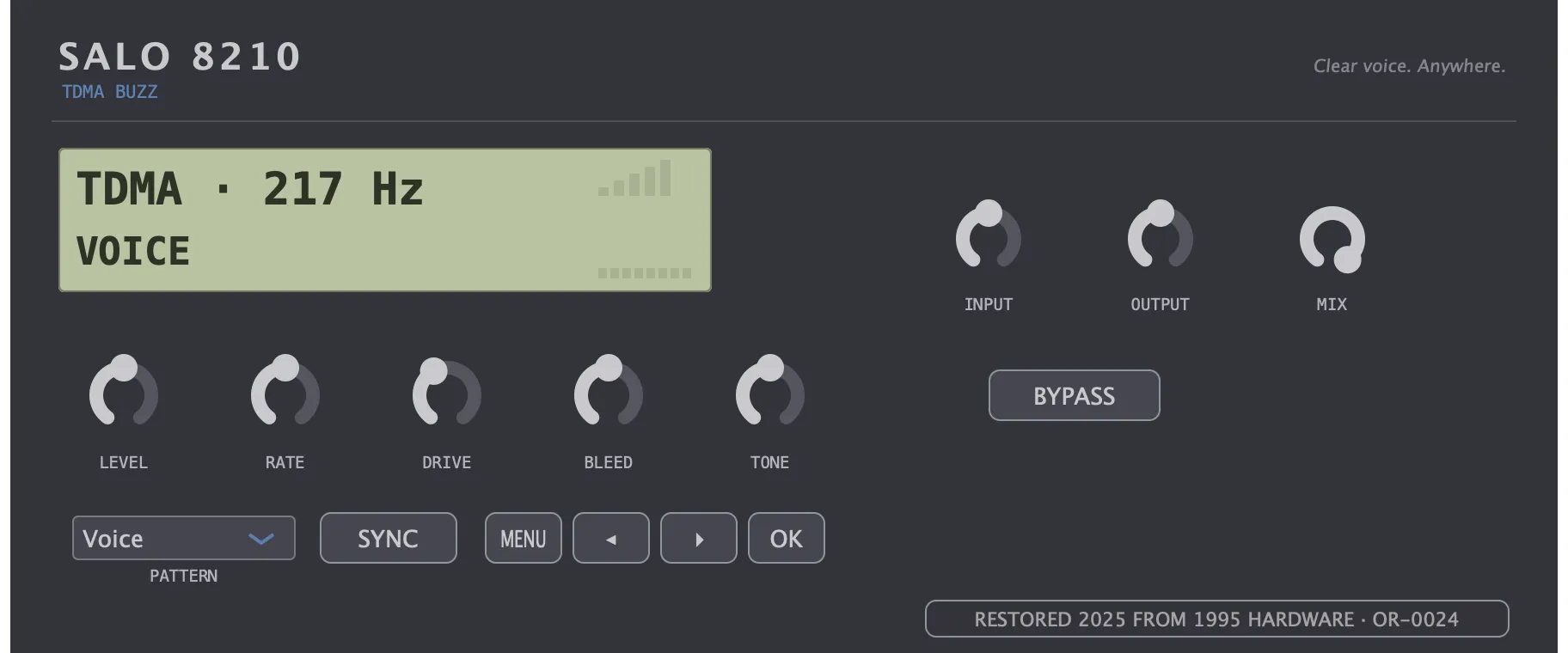
The controls
The controls.
- Level 0–100 % · 50 % as issued
- Sets how deeply the TDMA buzz is imposed on the signal.
- Rate 100–400 Hz · 217 Hz as issued
- Sets the TDMA frame rate that produces the buzz. With Sync on, it locks instead to a subdivision of your studio's tempo.
- Pattern Voice as issued
- Chooses the multiframe activity shaping the buzz's rhythm: Voice, Idle, SMS burst, or Custom.
- Drive 0–100 % · 40 % as issued
- Sets how hard the signal is rectified and ring-modulated — the nonlinearity behind the buzz.
- Bleed 0–100 % · 50 % as issued
- Crossfades between buzz ring-modulated into the signal and buzz added alongside it.
- Tone 200 Hz–6.0 kHz · 1.5 kHz as issued
- Tilts the brightness of the pulse train that produces the buzz.
- Sync Off as issued
- Locks the frame rate to a subdivision of your studio's tempo, for musical use in place of the fixed 217 Hz original.
- Input -24.00–24.00 dB · 0.00 dB as issued
- Sets the level going in, in decibels, before the signal reaches the restored circuit.
- Output -24.00–24.00 dB · 0.00 dB as issued
- Sets the level coming out, in decibels, after the restored circuit and the Mix blend.
- Mix 0–100 % · 100 % as issued
- Blends the restored circuit against the untouched signal at equal power, from the untouched signal alone at 0 % to the circuit alone at 100 %.
- Bypass Off as issued
- Takes the restored circuit out of the path and passes the untouched signal, delayed to match the circuit so nothing shifts in time.
A stored setup is a memory. MENU opens the list: the display reads MEMORY 03/12, with the memory's name below. ◂ ▸ step through it without changing the sound, and OK loads the one shown. Holding OK asks STORE? OK; OK again opens the name, which starts as USER NN. ◂ ▸ change the letter, OK moves on, and holding OK stores it; the computer keyboard may type the name instead, Return storing and Escape cancelling. Holding MENU on a user memory asks CLEAR? OK.
Listening
Listening
Demonstration recordings, prepared at the bench.
The handset, too close
The material plays clean for six seconds; then the buzz arrives at bench settings — Rate at 217 Hz, Pattern set to Voice — the cadence a handset leaves in nearby equipment.
0:00 / 0:30
Voice, Idle, SMS
Pattern is stepped through Voice, Idle, and SMS burst against a held pad — three cadences of the same interference — and Rate then climbs from 100 Hz to 400 Hz.
0:00 / 0:30
Buzz on the line
A call, interfered with deliberately: Drive at 90 % demodulates hard, Bleed crossfades from ring-modulated speech to the injected burst itself, Tone tilts the pulse dark and then bright, and Sync locks the frame rate briefly before it runs free again.
0:00 / 0:30