OR-0016
Tekura
Oregon, USA · 1979 – c. 2001
Ser. Type 1050 · Ser. No. 02207-A
1986 · effect
Issued as VST3 · AU
Restored 2024 from 1986 hardware.
Tekura 1050 — Reconstruction Filter
Tekura Type 1050 · Reconstruction Filter · restored from Ser. No. 02207-A · Tekura, Oregon, USA, 1986
The restorer's note
The output stage of a converter, isolated — the whole difference between "cheap digital" and "good digital," made a knob. Zero-order hold for the buzzy, imaged top; band-limited for the clean. One of Tekura's earliest designs, and still exact.
Acquisition
Prices are exclusive of tax. Customers in a country that charges VAT or sales tax will be liable at the rate set by that country; the relevant amount is added at checkout to the purchase price.
The plate
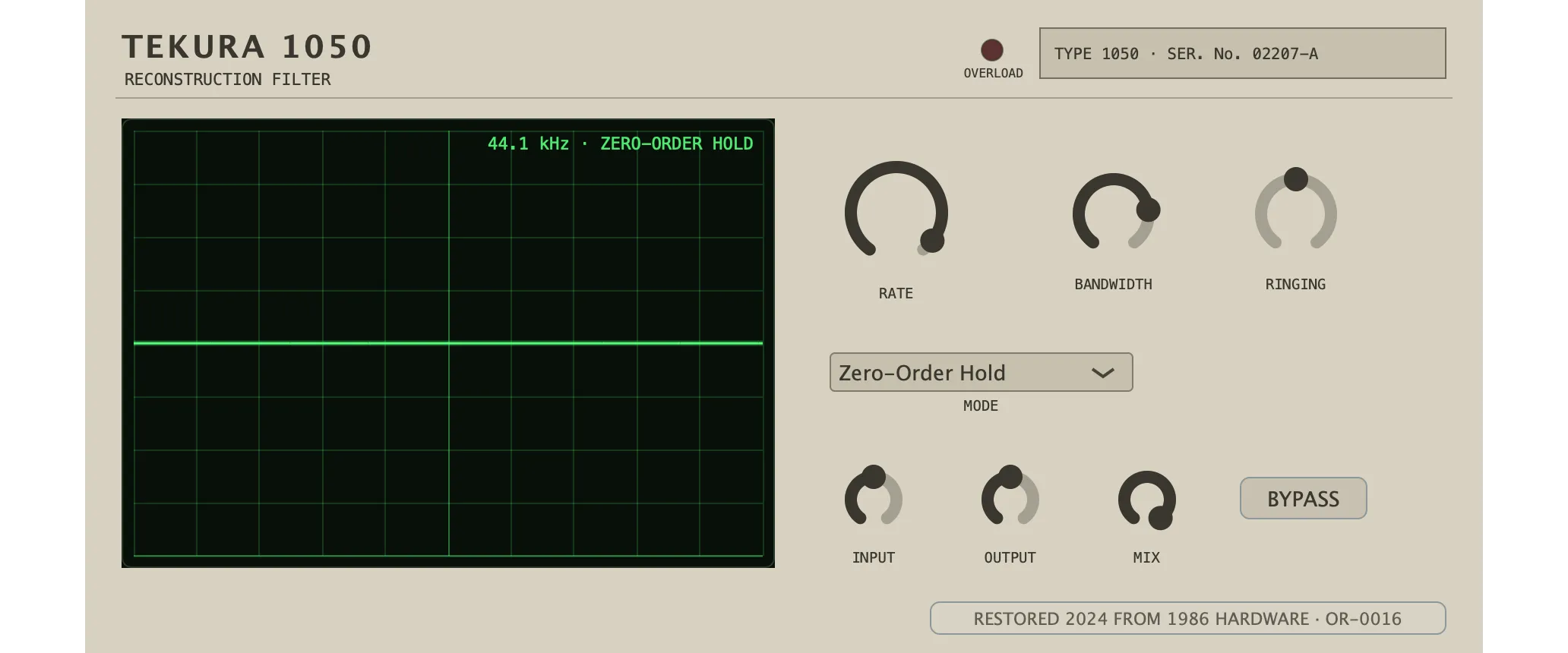
Listening
Listening
Demonstration recordings, prepared at the bench.
Twelve kilohertz, held
The mix runs dry for five seconds, then the converter model: Zero-Order Hold at a 12 kHz Rate. The images sit above the passband, unfiltered — here, the reconstruction is the instrument.
0:00 / 0:30
Forty-eight down to eight
Rate falls from 48 kHz to 8 kHz in one continuous move, Zero-Order Hold throughout. At the top the model is nearly transparent; by the bottom the images have walked down into the music.
0:00 / 0:30
Three reconstructions
The same figure at a 16 kHz Rate, three ways: Zero-Order Hold with its images, Band-limited clean, then Brickwall — Ringing raised to 100 % puts the pre-ring in front of every hit. Bandwidth closes to 8 kHz at the end.
0:00 / 0:30