OR-0022
Tekura
Oregon, USA · 1979 – c. 2001
Ser. Type 1100 · Ser. No. 00776-A
1989 · effect
Issued as VST3 · AU
Restored 2025 from 1989 hardware.
Tekura 1100 — Response Analyzer
Tekura Type 1100 · Response Analyzer · restored from Ser. No. 00776-A · Tekura, Oregon, USA, 1989
The restorer's note
The swept-sine rig that captured a room's impulse response — which is to say, a machine for taking spaces and playing through them. Point it at a hall, a cabinet, a piece of hardware, and keep the result. Measurement, quietly become convolution.
Acquisition
Prices are exclusive of tax. Customers in a country that charges VAT or sales tax will be liable at the rate set by that country; the relevant amount is added at checkout to the purchase price.
The plate
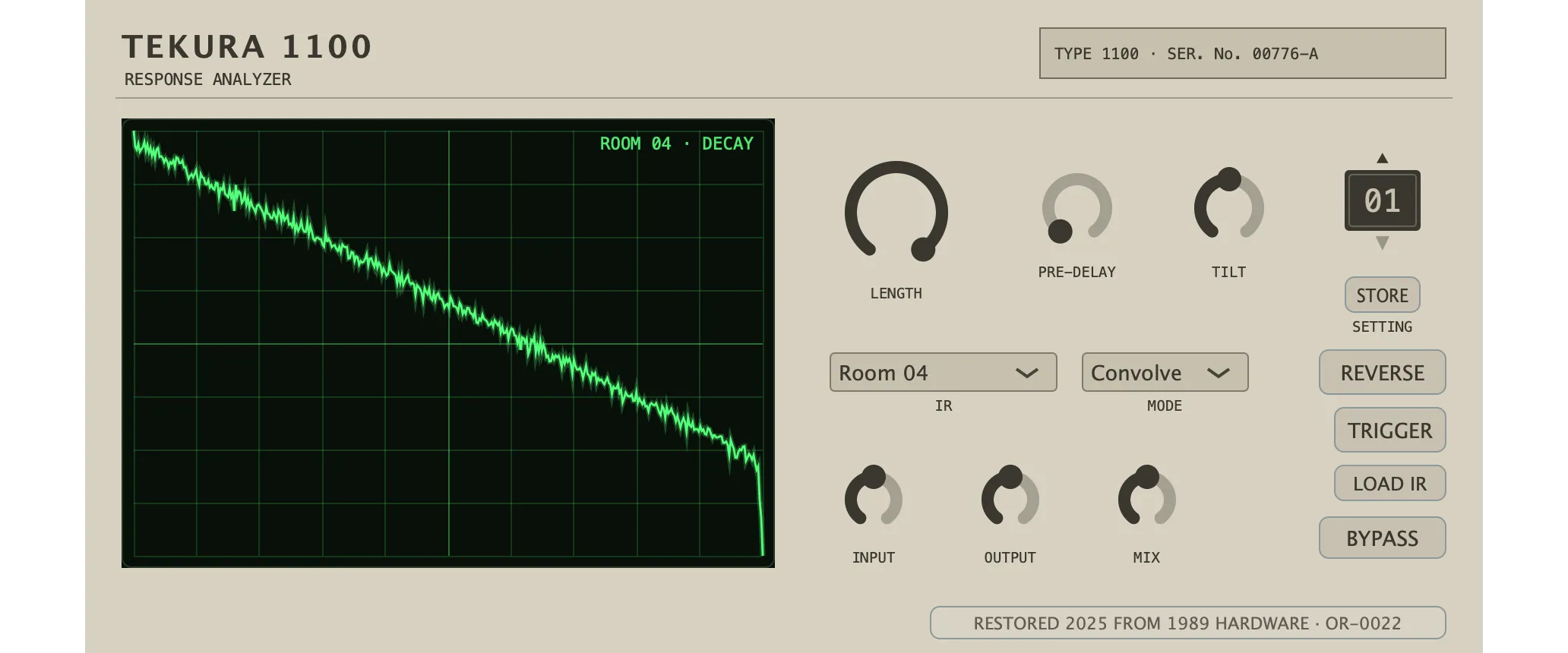
The controls
The controls.
- IR Room 04 as issued
- Chooses the impulse response played through: Room 04, Chamber 11, Plate 18, Cabinet C, or Bench Loop from the archive, a loaded File, or the Measured response captured on this unit.
- Mode Convolve as issued
- Chooses what the instrument does: Convolve plays the signal through the chosen impulse response; Measure captures a new one from what the Trigger sends out.
- Length 10–100 % · 100 % as issued
- Truncates the impulse response's tail, from the full response at 100 % down to a short fragment at 10 %.
- Pre-delay 0–200 ms · 0 ms as issued
- Sets a silent gap before the convolved signal arrives.
- Reverse Off as issued
- Plays the impulse response backwards.
- Tilt -6.0–6.0 dB/oct · 0.0 dB/oct as issued
- Tilts the impulse response's tone, in decibels per octave, brightening it above zero or darkening it below.
- Trigger Off as issued
- Fires the measurement sweep in Measure mode, sending it out to be captured as a new impulse response.
- Input -24.00–24.00 dB · 0.00 dB as issued
- Sets the level going in, in decibels, before the signal reaches the restored circuit.
- Output -24.00–24.00 dB · 0.00 dB as issued
- Sets the level coming out, in decibels, after the restored circuit and the Mix blend.
- Mix 0–100 % · 50 % as issued
- Blends the restored circuit against the untouched signal at equal power, from the untouched signal alone at 0 % to the circuit alone at 100 %.
- Bypass Off as issued
- Takes the restored circuit out of the path and passes the untouched signal, delayed to match the circuit so nothing shifts in time.
A stored setting is numbered, never named: the trace's overlay reads SETTING 04/09. The thumbwheel's position is the setting, and it applies as it clicks into place; ▲ ▼ step one at a time and stop at the ends. STORE asks STORE NN?, and a second press keeps the present state as SETTING NN. Holding STORE on a user setting asks CLEAR NN?, and a second press clears it.
Listening
Listening
Demonstration recordings, prepared at the bench.
Room 04, as measured
The hits run dry for five seconds, then Mix rises to 50 % and Room 04 answers — four tenths of a second of measured space behind every strike. Mode stays on Convolve; nothing is embellished.
0:00 / 0:30
Plate 18, cut short
Plate 18 with Length at 45 % — the measured decay cut mid-fall, a gated read of the archive. Mix rises to 65 %; at twenty-two seconds the direct signal leaves and only the clipped plate remains.
0:00 / 0:30
Reversed, then measured
Chamber 11 played backwards — Reverse on, Tilt at +6 dB/oct, Pre-delay at 120 ms — every hit answered by a swell that builds instead of decays. At twenty-four seconds Mode switches to Measure and the Trigger fires the sweep: the instrument taking its own reading.
0:00 / 0:30