OR-0021
Tekura
Oregon, USA · 1979 – c. 2001
Ser. Type 1200 · Ser. No. 03014-A
1982 · effect
Issued as VST3 · AU
Restored 2025 from 1982 hardware.
Tekura 1200 — Noise Reference
Tekura Type 1200 · Noise Reference · restored from Ser. No. 03014-A · Tekura, Oregon, USA, 1982
The restorer's note
The plainest thing in the catalogue and among the most useful — calibrated white, pink, and band-limited noise, test tones, and proper dither, all at exact levels. One of Tekura's oldest products, serial 03014, and it still measures true.
Acquisition
Prices are exclusive of tax. Customers in a country that charges VAT or sales tax will be liable at the rate set by that country; the relevant amount is added at checkout to the purchase price.
The plate
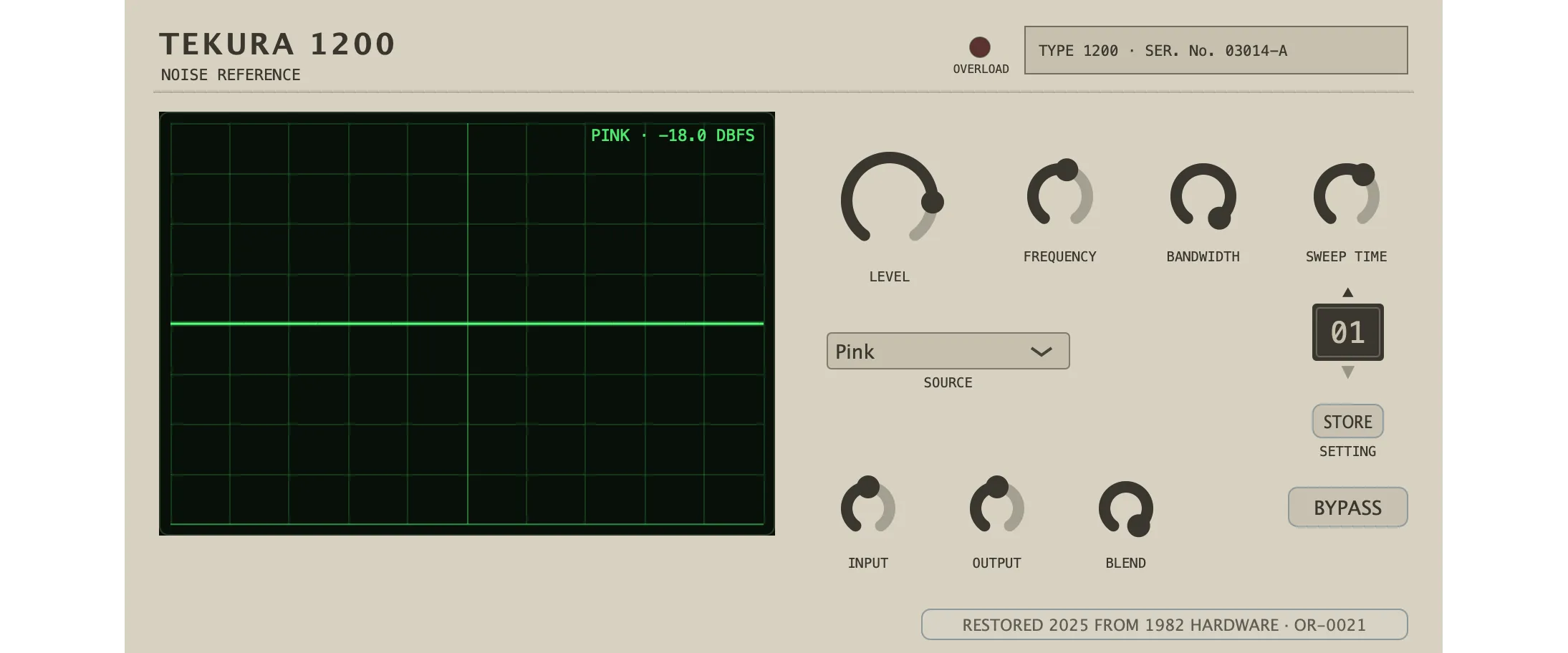
The controls
The controls.
- Source Pink as issued
- Chooses the generated signal: White, Pink, Band, Sine, Sweep, Impulse, or TPDF Dither.
- Level -100–0 dBFS · -18 dBFS as issued
- Sets the generated signal's calibrated output level, in decibels full scale.
- Frequency 20 Hz–20.0 kHz · 1.0 kHz as issued
- Sets the Sine's frequency, the Band noise's centre, or the Sweep's centre frequency; it has no effect on the other sources.
- Bandwidth 10 Hz–20.0 kHz · 20.0 kHz as issued
- Sets the Band noise's width, or the Sweep's frequency span; it has no effect on the other sources.
- Sweep Time 0.01–10.00 s · 1.00 s as issued
- Sets how long the Sweep takes to complete one pass, and the Impulse's repeat period between clicks; it has no effect on the other sources.
- Input -24.00–24.00 dB · 0.00 dB as issued
- Trims the incoming signal before it joins the Blend; the generated signal itself is unaffected by this control.
- Output -24.00–24.00 dB · 0.00 dB as issued
- Sets the level coming out, in decibels, after the restored circuit and the Mix blend.
- Blend 0–100 % · 100 % as issued
- Blends the generated signal against the input, from the input alone at 0 % to the generated signal alone, replacing it, at 100 %.
- Bypass Off as issued
- Takes the restored circuit out of the path and passes the untouched signal, delayed to match the circuit so nothing shifts in time.
A stored setting is numbered, never named: the trace's overlay reads SETTING 04/09. The thumbwheel's position is the setting, and it applies as it clicks into place; ▲ ▼ step one at a time and stop at the ends. STORE asks STORE NN?, and a second press keeps the present state as SETTING NN. Holding STORE on a user setting asks CLEAR NN?, and a second press clears it.
Listening
Listening
Demonstration recordings, prepared at the bench.
The reference, blended
Pink noise at Level −18 dBFS, Blend at 100 — the reference alone. At eight seconds Blend falls to 50 and the material comes up through the noise; at twenty it drops to 25, the reference now a calibrated bed.
0:00 / 0:30
The source walk
White; Band noise 500 Hz wide around 1 kHz, the centre then moved to 4 kHz; a Sine at 440 and again at 1 kHz; a Sweep on a two-second period; and the Impulse, once a second, to close. Level holds at −18 dBFS throughout.
0:00 / 0:30
A dither bed
TPDF Dither blended at 30 under the material, Level at −18 dBFS. The bed falls away to −40 by fourteen seconds and returns to −18 at twenty — a calibrated hiss.
0:00 / 0:30