OR-0014
Tekura
Oregon, USA · 1979 – c. 2001
Ser. Type 1601 · Ser. No. 00092-A
1992 · effect
Issued as VST3 · AU
Restored 2024 from 1992 hardware.
Tekura 1601 — Jitter Reference
Tekura Type 1601 · Jitter Reference · restored from Ser. No. 00092-A · Tekura, Oregon, USA, 1992
The restorer's note
A device for adding clock jitter in exact, calibrated amounts — which, as an effect, is a subtle frequency-dependent shimmer no other tool quite makes. Serial 00092: very early, very low. The sidebands scale with pitch, exactly as the instrument intended.
Acquisition
Prices are exclusive of tax. Customers in a country that charges VAT or sales tax will be liable at the rate set by that country; the relevant amount is added at checkout to the purchase price.
The plate
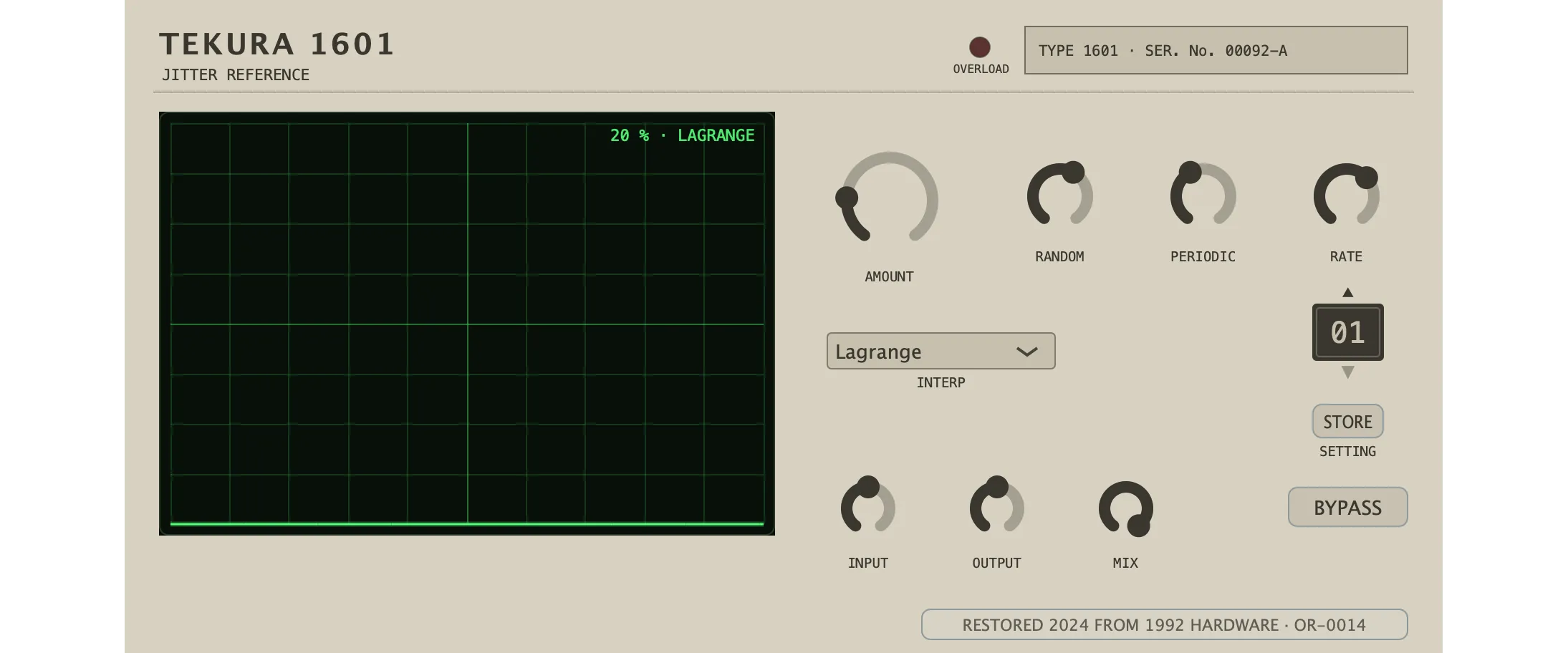
The controls
The controls.
- Amount 0–100 % · 20 % as issued
- Sets the overall magnitude of the jitter imposed on the clock, calibrated in picoseconds, from none at 0 % to the unit's full range at 100 %.
- Random 0–100 % · 60 % as issued
- Sets the broadband, random share of the jitter.
- Periodic 0–100 % · 40 % as issued
- Sets the sinusoidal, periodic share of the jitter, which shows up as discrete sidebands around the signal rather than broadband noise.
- Rate 1 Hz–5.0 kHz · 400 Hz as issued
- Sets the frequency of the periodic jitter component.
- Interp Lagrange as issued
- Chooses the fractional-delay interpolation behind the jitter: Lagrange or Thiran.
- Input -24.00–24.00 dB · 0.00 dB as issued
- Sets the level going in, in decibels, before the signal reaches the restored circuit.
- Output -24.00–24.00 dB · 0.00 dB as issued
- Sets the level coming out, in decibels, after the restored circuit and the Mix blend.
- Mix 0–100 % · 100 % as issued
- Blends the restored circuit against the untouched signal at equal power, from the untouched signal alone at 0 % to the circuit alone at 100 %.
- Bypass Off as issued
- Takes the restored circuit out of the path and passes the untouched signal, delayed to match the circuit so nothing shifts in time.
A stored setting is numbered, never named: the trace's overlay reads SETTING 04/09. The thumbwheel's position is the setting, and it applies as it clicks into place; ▲ ▼ step one at a time and stop at the ends. STORE asks STORE NN?, and a second press keeps the present state as SETTING NN. Holding STORE on a user setting asks CLEAR NN?, and a second press clears it.
Listening
Listening
Demonstration recordings, prepared at the bench.
The calibrated wander
The pad runs dry for five seconds, then the bench calibration: Amount at 20 %, Random at 60, Periodic at 40, Rate at 400 Hz. A fine unsteadiness in the top of the chord — more felt than heard, which is the point of a reference.
0:00 / 0:30
Sidebands on schedule
Amount rises from 0 to 100 % over calibrated tones, then Rate walks from 1 Hz to 5 kHz. The sidebands step away from each tone as the periodic component climbs — exactly where the arithmetic says they should be.
0:00 / 0:30
Random against periodic
Amount held at 70 %. The first half is Random alone — a broadband smear across the chord; at twelve seconds Periodic takes over and the smear resolves into discrete sidebands at the Rate. Interp moves to Thiran for the close.
0:00 / 0:30