OR-0013
Tekura
Oregon, USA · 1979 – c. 2001
Ser. Type 2200 · Ser. No. 01138-B
1990 · effect
Issued as VST3 · AU
Restored 2024 from 1990 hardware.
Tekura 2200 — Signal Decimator
Tekura Type 2200 · Signal Decimator · restored from Ser. No. 01138-B · Tekura, Oregon, USA, 1990
The restorer's note
Where most sample-rate reducers hide the aliasing, Tekura's instrument makes it a measured choice — clean band-limited decimation, or the folded-over kind, on a switch. An engineer's honesty, put to destructive use. Restored from a revision-B bench unit.
Acquisition
Prices are exclusive of tax. Customers in a country that charges VAT or sales tax will be liable at the rate set by that country; the relevant amount is added at checkout to the purchase price.
The plate
Listening
Listening
Demonstration recordings, prepared at the bench.
Eleven kilohertz, plainly
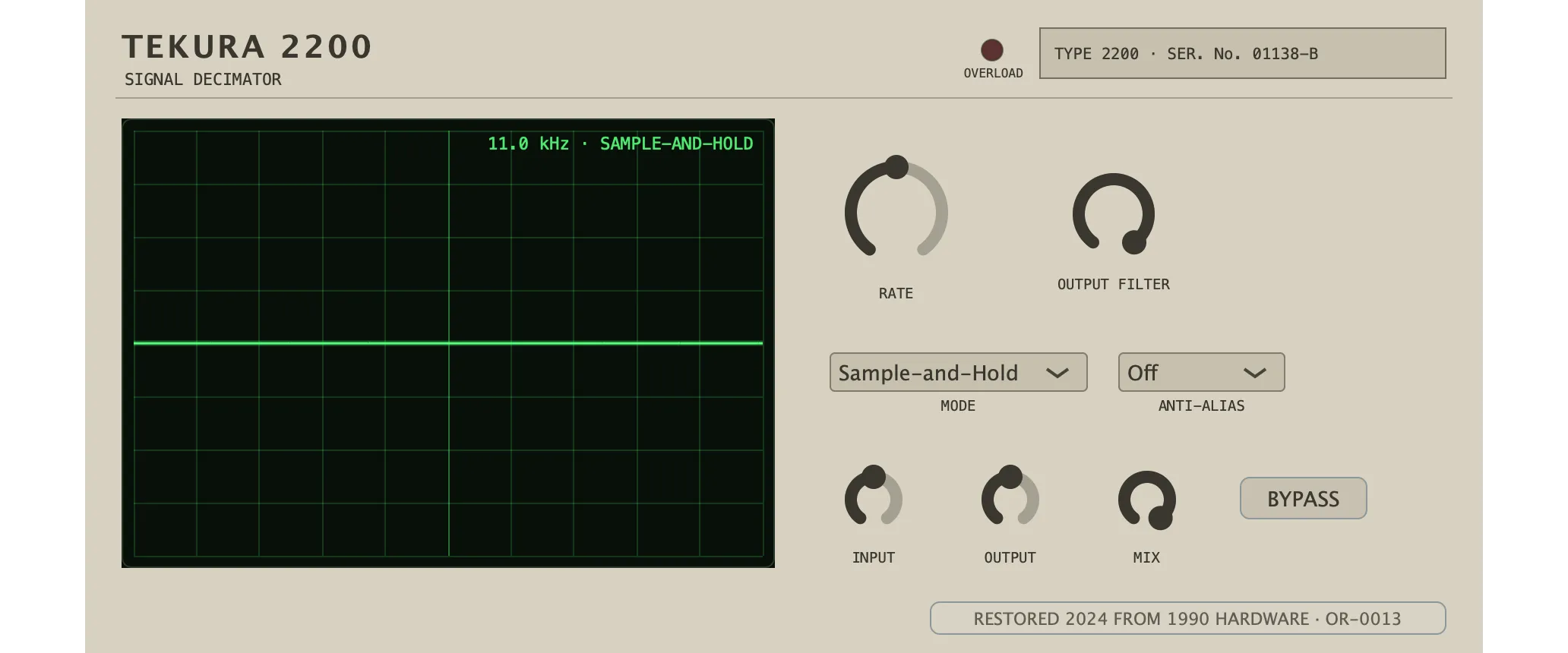
The phrase runs dry for five seconds, then the bench default: sample-and-hold to 11.025 kHz, anti-alias off. The top octave folds back into the material.
0:00 / 0:30
The rate walked down
Rate is walked from 26 kHz down to 1 kHz in one pass — sample-and-hold, no anti-alias filter. The foldover arrives on schedule; nothing here is misbehaving.
0:00 / 0:30
Two ways down
The same figure taken down two ways: Band-limited at 4 kHz with the anti-alias filter in, then Sample-and-Hold with it out. The Output Filter closes to 3.5 kHz at the end.
0:00 / 0:30