OR-0015
Tekura
Oregon, USA · 1979 – c. 2001
Ser. Type 3100 · Ser. No. 00461-C
1994 · effect
Issued as VST3 · AU
Restored 2024 from 1994 hardware.
Tekura 3100 — Perceptual Codec
Tekura Type 3100 · Perceptual Codec analyzer · restored from Ser. No. 00461-C · Tekura, Oregon, USA, 1994
The restorer's note
Tekura put the masking model on the front panel so you could watch compression decide what to discard. Push it and the artifacts arrive on schedule — pre-echo, dulled highs — because they are physics, not seasoning. Restored from a revision-C unit.
Acquisition
Prices are exclusive of tax. Customers in a country that charges VAT or sales tax will be liable at the rate set by that country; the relevant amount is added at checkout to the purchase price.
The plate
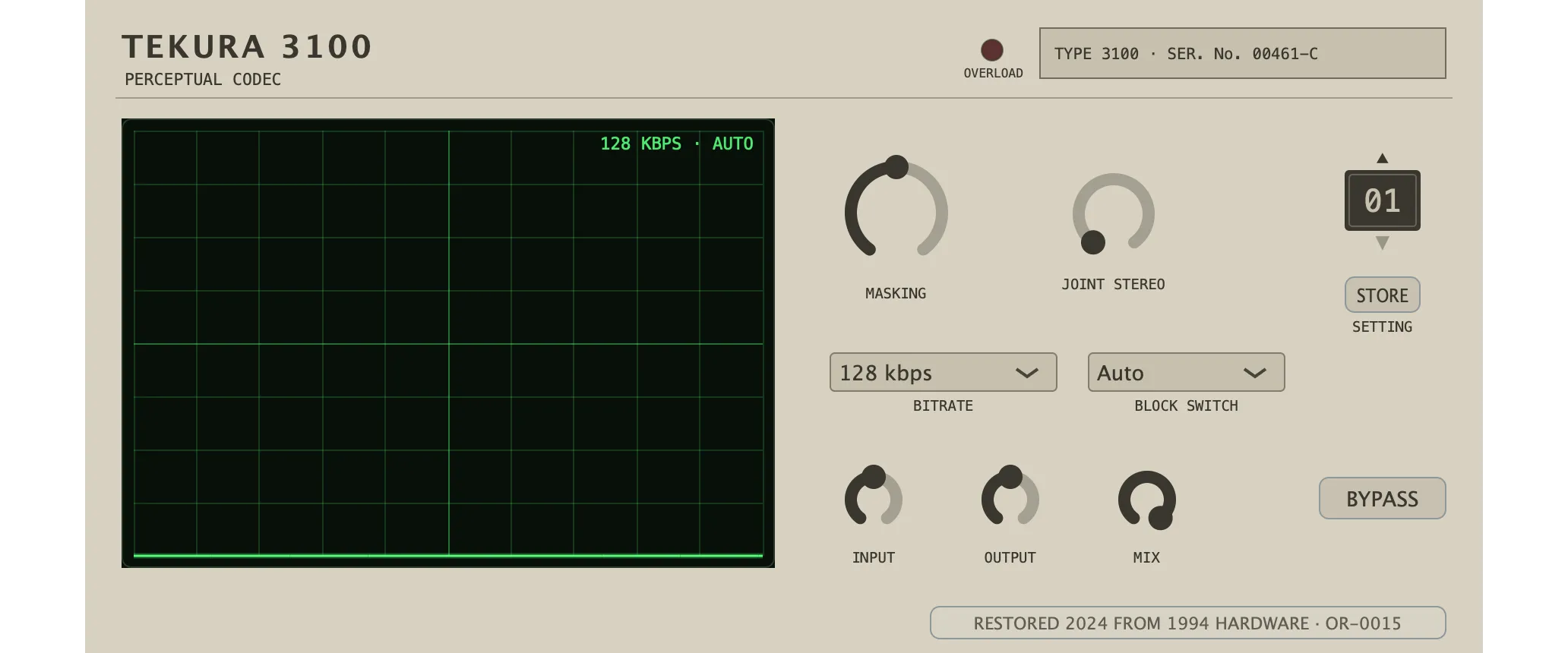
The controls
The controls.
- Bitrate 128 kbps as issued
- Sets the coded bitrate: 32, 48, 64, 80, 96, 112, 128, 160, 192, 224, 256, or 320 kbps. Lower rates leave the masking model less room, so more is discarded.
- Masking -12.0–12.0 dB · 0.0 dB as issued
- Shifts the masking threshold the coder uses to decide what to discard, in decibels either side of its own calculated value.
- Block Switch Auto as issued
- Chooses whether the coding window switches to a shorter block on a transient: Auto prevents pre-echo; Off keeps one window length throughout.
- Joint Stereo 0–100 % · 0 % as issued
- Sets how much the stereo image collapses to intensity-coded mono once coded, from none at 0 % to full collapse at 100 %.
- Input -24.00–24.00 dB · 0.00 dB as issued
- Sets the level going in, in decibels, before the signal reaches the restored circuit.
- Output -24.00–24.00 dB · 0.00 dB as issued
- Sets the level coming out, in decibels, after the restored circuit and the Mix blend.
- Mix 0–100 % · 100 % as issued
- Blends the restored circuit against the untouched signal at equal power, from the untouched signal alone at 0 % to the circuit alone at 100 %.
- Bypass Off as issued
- Takes the restored circuit out of the path and passes the untouched signal, delayed to match the circuit so nothing shifts in time.
A stored setting is numbered, never named: the trace's overlay reads SETTING 04/09. The thumbwheel's position is the setting, and it applies as it clicks into place; ▲ ▼ step one at a time and stop at the ends. STORE asks STORE NN?, and a second press keeps the present state as SETTING NN. Holding STORE on a user setting asks CLEAR NN?, and a second press clears it.
Listening
Listening
Demonstration recordings, prepared at the bench.
One twenty-eight, nominal
The mix runs dry for five seconds, then the codec takes it at Bitrate 128 kbps, Block Switch on Auto. What goes missing is what the masking model says you would not have heard anyway — mostly.
0:00 / 0:30
Down the ladder
Bitrate steps from 320 down to 32 kbps in six moves. The top of the band thins first, then the texture; by 32 kbps the model is rationing, and it shows.
0:00 / 0:30
The threshold, moved
At 96 kbps, Masking rises to +12 dB — the model discards more than it should — then falls to −12, where it keeps what it need not. Block Switch goes Off at twenty seconds and the hits smear forward; Joint Stereo closes the image at the end.
0:00 / 0:30