OR-0020
Tekura
Oregon, USA · 1979 – c. 2001
Ser. Type 4200 · Ser. No. 00589-B
1985 · effect
Issued as VST3 · AU
Restored 2025 from 1985 hardware.
Tekura 4200 — Distortion Analyzer
Tekura Type 4200 · Distortion Analyzer · restored from Ser. No. 00589-B · Tekura, Oregon, USA, 1985
The restorer's note
An instrument that measures harmonic distortion — and, run backwards, adds exactly the harmonics you specify, to the tenth of a percent. "Clean distortion" is a contradiction only until you use this. Restored from a mid-80s revision-B unit.
Acquisition
Prices are exclusive of tax. Customers in a country that charges VAT or sales tax will be liable at the rate set by that country; the relevant amount is added at checkout to the purchase price.
The plate
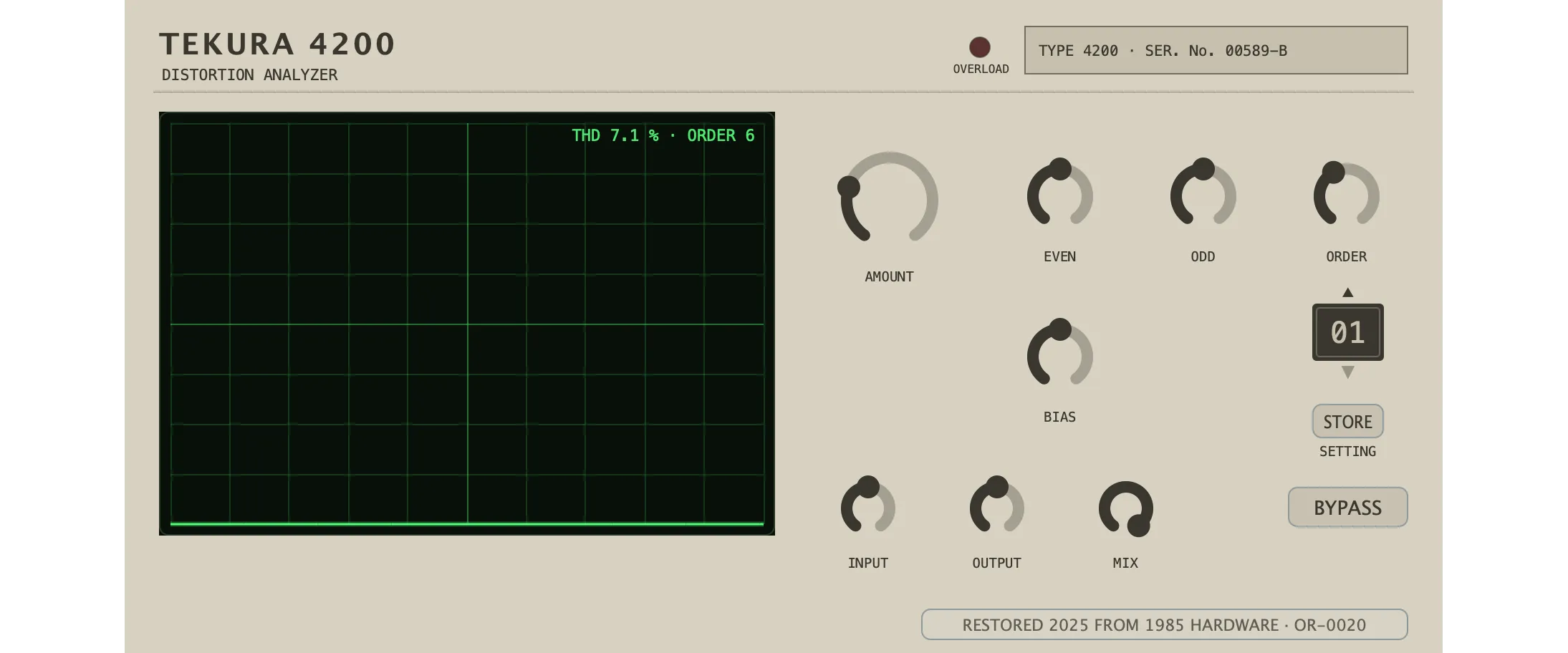
The controls
The controls.
- Amount 0–100 % · 25 % as issued
- Sets the overall depth of the generated distortion, read out on the panel as a THD percentage.
- Even 0–100 % · 50 % as issued
- Sets the level of the even harmonics generated — the 2nd and 4th.
- Odd 0–100 % · 50 % as issued
- Sets the level of the odd harmonics generated — the 3rd and 5th.
- Order 2–12 · 6 as issued
- Sets the highest harmonic generated; a higher order reaches further up and brightens the result.
- Bias -100–100 % · 0 % as issued
- Sets a waveform asymmetry that shifts the balance between the even and odd harmonics generated.
- Input -24.00–24.00 dB · 0.00 dB as issued
- Sets the level going in, in decibels, before the signal reaches the restored circuit.
- Output -24.00–24.00 dB · 0.00 dB as issued
- Sets the level coming out, in decibels, after the restored circuit and the Mix blend.
- Mix 0–100 % · 100 % as issued
- Blends the restored circuit against the untouched signal at equal power, from the untouched signal alone at 0 % to the circuit alone at 100 %.
- Bypass Off as issued
- Takes the restored circuit out of the path and passes the untouched signal, delayed to match the circuit so nothing shifts in time.
A stored setting is numbered, never named: the trace's overlay reads SETTING 04/09. The thumbwheel's position is the setting, and it applies as it clicks into place; ▲ ▼ step one at a time and stop at the ends. STORE asks STORE NN?, and a second press keeps the present state as SETTING NN. Holding STORE on a user setting asks CLEAR NN?, and a second press clears it.
Listening
Listening
Demonstration recordings, prepared at the bench.
Twenty-five per cent
The chords run dry for five seconds, then through the generator at Amount 25 % — Even and Odd both at 50, Order at 6. A measured warmth; the readout would call it THD, and it would be right.
0:00 / 0:30
The series, in order
Amount rises from 0 to 100 % over calibrated tones. The harmonic series climbs out of the sine, evens and odds together, up to Order 6 — exactly as commissioned.
0:00 / 0:30
Even against odd
Amount at 60 %: the even series alone, then the odd series alone at eight seconds. Order jumps to 12 and the edge brightens; back to 2 — with Even restored — only the octave remains. Bias tips the balance at the close.
0:00 / 0:30