OR-0017
Tekura
Oregon, USA · 1979 – c. 2001
Ser. Type 5150 · Ser. No. 00318-B
1991 · effect
Issued as VST3 · AU
Restored 2025 from 1991 hardware.
Tekura 5150 — DAT Reference
Tekura Type 5150 · DAT Reference · restored from Ser. No. 00318-B · Tekura, Oregon, USA, 1991
The restorer's note
Sixteen-bit that is almost, but not quite, clean — the faint patina a good DAT machine leaves on a master. This is a finishing tool; every parameter is meant to sit just below notice. Restored to reference spec, which in Tekura's world meant leaving well alone.
Acquisition
Prices are exclusive of tax. Customers in a country that charges VAT or sales tax will be liable at the rate set by that country; the relevant amount is added at checkout to the purchase price.
The plate
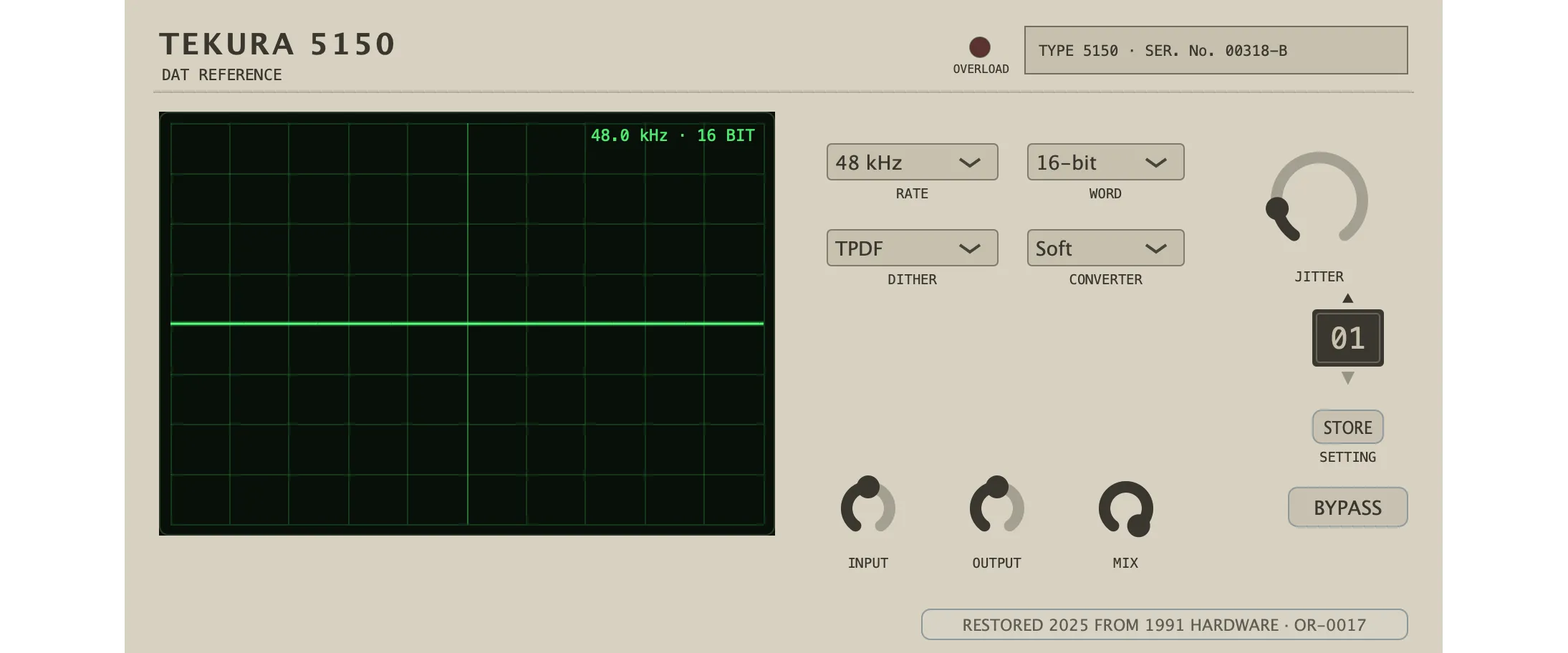
The controls
The controls.
- Rate 48 kHz as issued
- Sets the DAT sample rate: 48 kHz, 44.1 kHz, or 32 kHz, the format's long-play mode with a narrower band.
- Word 16-bit as issued
- Sets the quantizer's word length: 16-bit, the format's standard depth, or 14-bit, a reduced-depth alternative.
- Jitter 0–100 % · 15 % as issued
- Sets the clock jitter imposed on the signal: the Tekura 1601's own jitter, kept here to a subtle range.
- Dither TPDF as issued
- Switches the dither ahead of the 16-bit quantizer: Off, or TPDF.
- Converter Soft as issued
- Chooses the output stage's character: Soft, a gently band-limited reconstruction, or Brickwall, a sharper reconstruction with pre-ringing.
- Input -24.00–24.00 dB · 0.00 dB as issued
- Sets the level going in, in decibels, before the signal reaches the restored circuit.
- Output -24.00–24.00 dB · 0.00 dB as issued
- Sets the level coming out, in decibels, after the restored circuit and the Mix blend.
- Mix 0–100 % · 100 % as issued
- Blends the restored circuit against the untouched signal at equal power, from the untouched signal alone at 0 % to the circuit alone at 100 %.
- Bypass Off as issued
- Takes the restored circuit out of the path and passes the untouched signal, delayed to match the circuit so nothing shifts in time.
A stored setting is numbered, never named: the trace's overlay reads SETTING 04/09. The thumbwheel's position is the setting, and it applies as it clicks into place; ▲ ▼ step one at a time and stop at the ends. STORE asks STORE NN?, and a second press keeps the present state as SETTING NN. Holding STORE on a user setting asks CLEAR NN?, and a second press clears it.
Listening
Listening
Demonstration recordings, prepared at the bench.
A finishing tool
The reference pass at 48 kHz, 16-bit Word, TPDF Dither, Soft Converter — in at six seconds, out at sixteen, in again at twenty-two. The difference sits at the edge of notice. That is the instrument.
0:00 / 0:30
Long-play
Rate steps from 48 to 44.1 kHz — a move below notice — then to 32 kHz, the long-play speed, and the top octave is gone. Word drops to 14-bit at twenty seconds and the floor comes up to meet the tape.
0:00 / 0:30
Out of calibration
Jitter raised to 80 % blurs the top end; Converter switches to Brickwall at twelve seconds and rings at the band edge; Dither goes Off at twenty and the quiet detail truncates. None of it is loud. All of it is there.
0:00 / 0:30