OR-0018
Tekura
Oregon, USA · 1979 – c. 2001
Ser. Type 6100 · Ser. No. 00203-A
1995 · effect
Issued as VST3 · AU
Restored 2025 from 1995 hardware.
Tekura 6100 — Spectrum Analyzer
Tekura Type 6100 · Spectrum Analyzer · restored from Ser. No. 00203-A · Tekura, Oregon, USA, 1995
The restorer's note
The real-time spectrum bench, which we could not resist teaching to hold. Freeze a frame and it becomes a drone; gate the quiet bins and it becomes a filter. The measurement is honest; the effects are ours, added lightly.
Acquisition
Prices are exclusive of tax. Customers in a country that charges VAT or sales tax will be liable at the rate set by that country; the relevant amount is added at checkout to the purchase price.
The plate
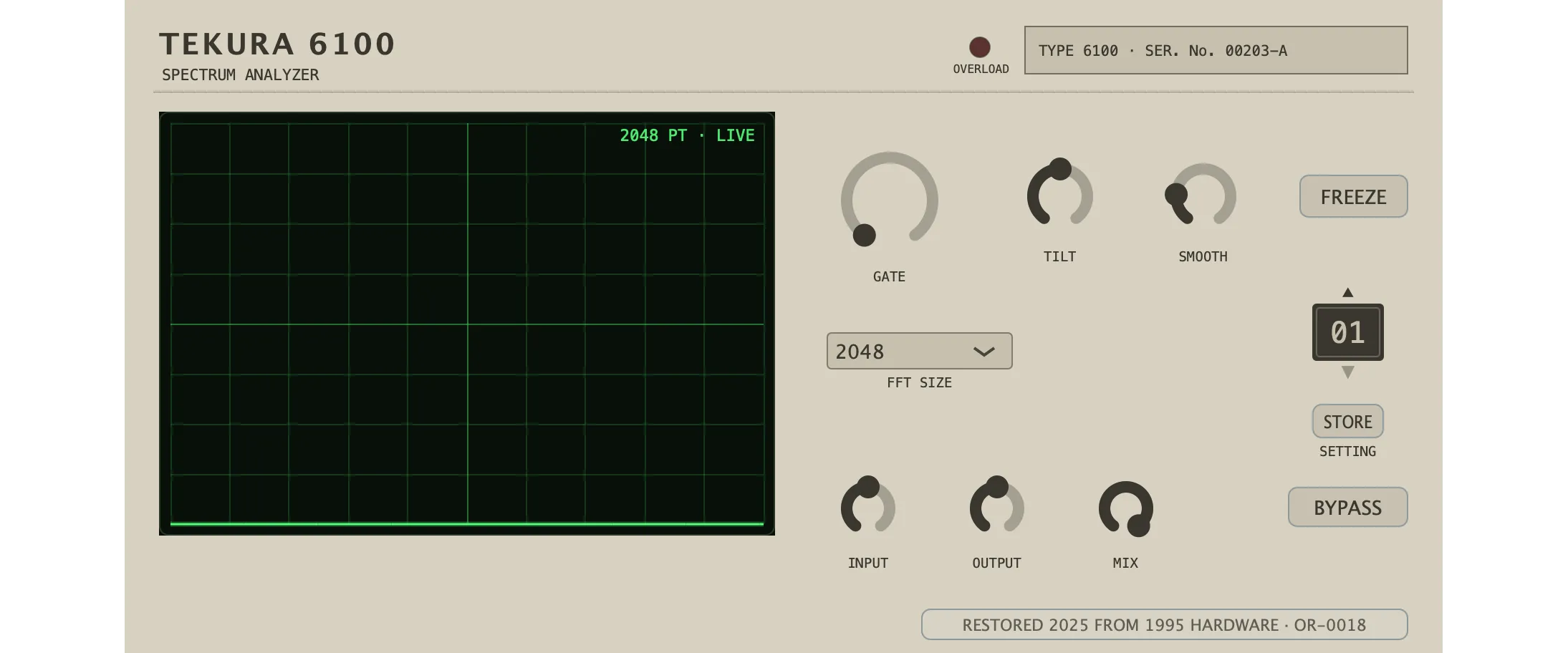
The controls
The controls.
- FFT Size 2048 as issued
- Sets the transform size: 512, 1024, 2048, 4096, or 8192 samples. A larger size reads frequency more finely, at the cost of more delay, which your studio compensates.
- Freeze Off as issued
- Holds the current spectral frame in place instead of updating it, turning the processed signal into a static drone.
- Gate -90.0–0.0 dB · -90.0 dB as issued
- Mutes any frequency bin quieter than this threshold, in decibels, turning the analyzer into a spectral filter; at its lowest setting, nothing is muted.
- Tilt -6.0–6.0 dB/oct · 0.0 dB/oct as issued
- Tilts the spectrum's brightness, boosting highs and cutting lows above zero, or the reverse below it, in decibels per octave.
- Smooth 0–100 % · 20 % as issued
- Sets how much each spectral frame is averaged with the frames before it, smoothing both the display and the processed sound.
- Input -24.00–24.00 dB · 0.00 dB as issued
- Sets the level going in, in decibels, before the signal reaches the restored circuit.
- Output -24.00–24.00 dB · 0.00 dB as issued
- Sets the level coming out, in decibels, after the restored circuit and the Mix blend.
- Mix 0–100 % · 100 % as issued
- Blends the restored circuit against the untouched signal at equal power, from the untouched signal alone at 0 % to the circuit alone at 100 %.
- Bypass Off as issued
- Takes the restored circuit out of the path and passes the untouched signal, delayed to match the circuit so nothing shifts in time.
A stored setting is numbered, never named: the trace's overlay reads SETTING 04/09. The thumbwheel's position is the setting, and it applies as it clicks into place; ▲ ▼ step one at a time and stop at the ends. STORE asks STORE NN?, and a second press keeps the present state as SETTING NN. Holding STORE on a user setting asks CLEAR NN?, and a second press clears it.
Listening
Listening
Demonstration recordings, prepared at the bench.
Plus four per octave
The pad runs dry for five seconds, then returns through the analyzer with Tilt at +4 dB/oct — the spectrum redrawn brighter than it arrived. FFT Size holds at 2048.
0:00 / 0:30
Gate rising
FFT Size at 512. Gate rises from −90 to −30 dB across fourteen seconds: bins below the threshold go dark and the pad thins to its loudest partials. The threshold falls away at twenty-two and the rest returns.
0:00 / 0:30
Held frame
FFT Size at 8192, Smooth raised to 80 %. Freeze engages at ten seconds and the analyzer holds its frame — the chord becomes a surface — until it lets go at twenty-four and the pad moves again.
0:00 / 0:30