OR-0019
Tekura
Oregon, USA · 1979 – c. 2001
Ser. Type 6200 · Ser. No. 00147-A
1996 · effect
Issued as VST3 · AU
Restored 2025 from 1996 hardware.
Tekura 6200 — Correlation Analyzer
Tekura Type 6200 · Correlation Analyzer · restored from Ser. No. 00147-A · Tekura, Oregon, USA, 1996
The restorer's note
The goniometer and phase meter that told an engineer whether a mix would survive mono. Restored with its stereo tools intact — width, fold-down, rotation — and not one of them flattering. Tekura did not do flattering.
Acquisition
Prices are exclusive of tax. Customers in a country that charges VAT or sales tax will be liable at the rate set by that country; the relevant amount is added at checkout to the purchase price.
The plate
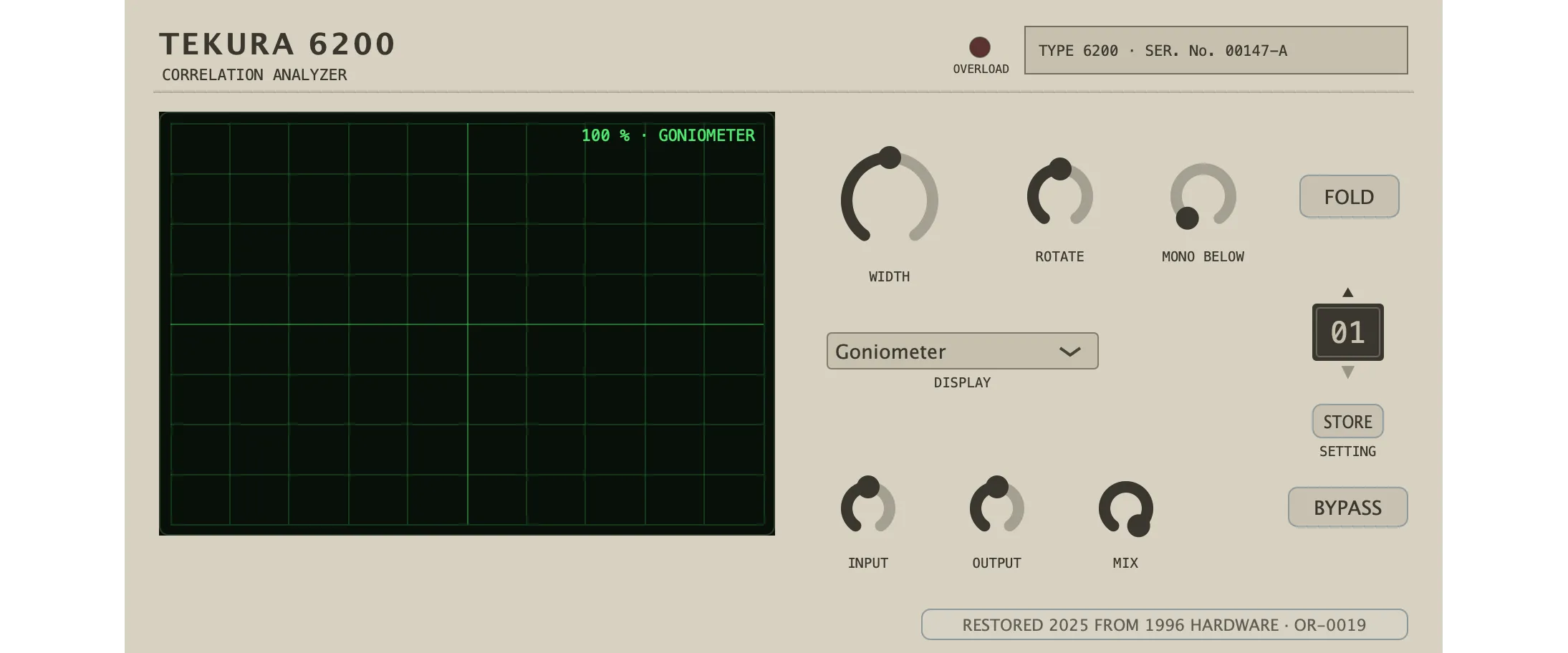
The controls
The controls.
- Width 0–200 % · 100 % as issued
- Sets the stereo width via the mid/side matrix, from fully mono at 0 % through the original image at 100 % up to an exaggerated 200 %.
- Rotate -45.0–45.0 ° · 0.0 ° as issued
- Rotates the stereo field left or right, in degrees, without changing its width.
- Mono Below Off–500 Hz · Off as issued
- Sums frequencies below this corner to mono, protecting bass from cancelling in mono playback; below 50 Hz the control reads Off and leaves the image untouched.
- Fold Off as issued
- Folds the stereo signal down to mono, in place, so you can audition whether the mix survives it.
- Display Goniometer as issued
- Chooses what the screen reads: Goniometer, the Lissajous figure traced by the left/right pair, or Correlation, a numeric meter of the same relationship.
- Input -24.00–24.00 dB · 0.00 dB as issued
- Sets the level going in, in decibels, before the signal reaches the restored circuit.
- Output -24.00–24.00 dB · 0.00 dB as issued
- Sets the level coming out, in decibels, after the restored circuit and the Mix blend.
- Mix 0–100 % · 100 % as issued
- Blends the restored circuit against the untouched signal at equal power, from the untouched signal alone at 0 % to the circuit alone at 100 %.
- Bypass Off as issued
- Takes the restored circuit out of the path and passes the untouched signal, delayed to match the circuit so nothing shifts in time.
A stored setting is numbered, never named: the trace's overlay reads SETTING 04/09. The thumbwheel's position is the setting, and it applies as it clicks into place; ▲ ▼ step one at a time and stop at the ends. STORE asks STORE NN?, and a second press keeps the present state as SETTING NN. Holding STORE on a user setting asks CLEAR NN?, and a second press clears it.
Listening
Listening
Demonstration recordings, prepared at the bench.
One-sixty wide
The pad runs dry for five seconds, then through the M/S matrix at Width 160 % — pushed past unity, the sides carrying more than they were given. Nothing is corrected; the device does only what it is told.
0:00 / 0:30
Zero to two hundred
Width falls to mono by nine seconds, then opens to 200 % by eighteen. Rotate swings the field to +45° and snaps to −45° at the close — a line, a cloud, and a tilt, in that order.
0:00 / 0:30
The mono audition
Mono Below sums the low end under 300 Hz at six seconds. Fold auditions the whole mix in mono from twelve to eighteen. Display switches to Correlation at the end — a change of reading, not of signal.
0:00 / 0:30