OR-0036
Yumeo
Japan · 1985 – c. 2005
Ser. D-1183902
1990 · effect
Issued as VST3 · AU
Restored 2026 from 1990 hardware.
Yumeo DAT-7 — DAT Deck
Yumeo DAT-7 · digital audio tape deck · restored from unit no. D-1183902 · Yumeo, Japan, 1990
The restorer's note
The consumer DAT deck — sixteen honest bits, voiced for the living room rather than the lab. Where Tekura's DAT is clinical, this one carries the deck's own converters and their quiet colour. Restored from a well-kept home unit.
Acquisition
Prices are exclusive of tax. Customers in a country that charges VAT or sales tax will be liable at the rate set by that country; the relevant amount is added at checkout to the purchase price.
The plate
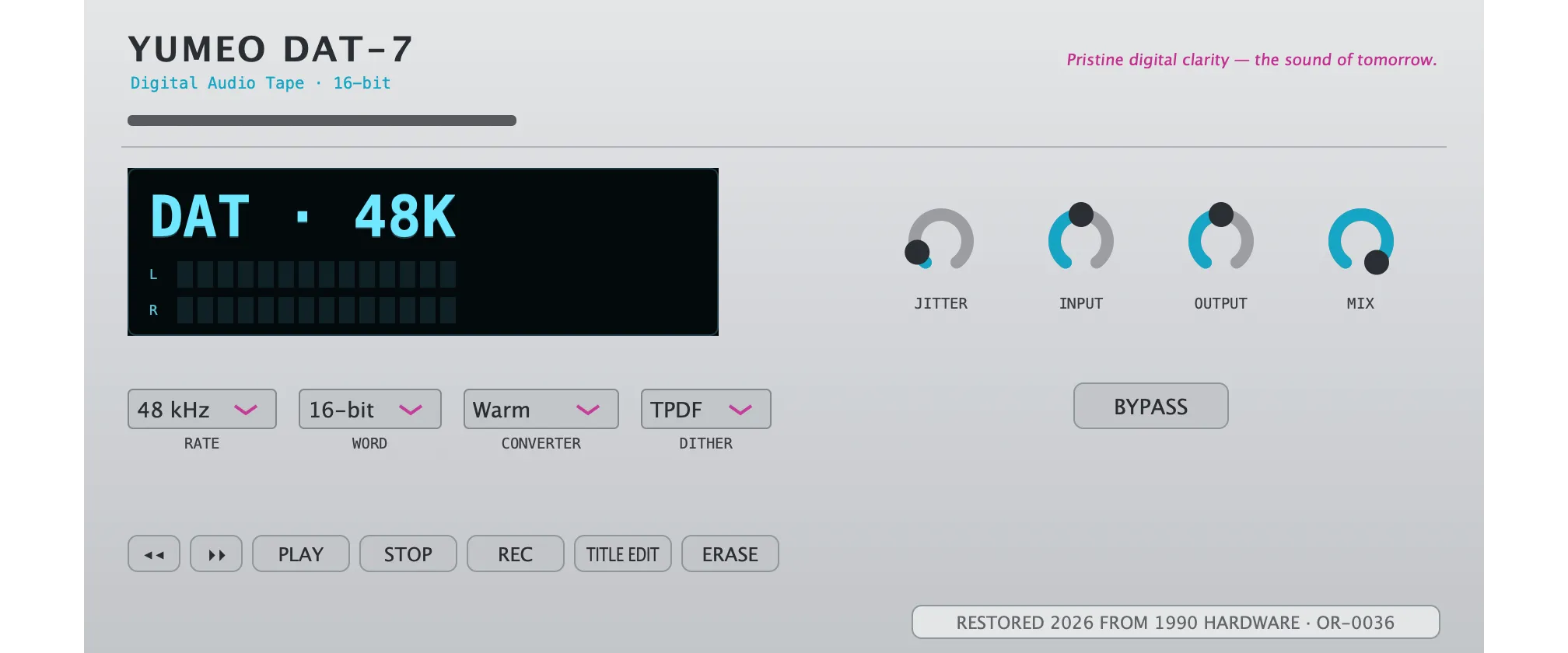
The controls
The controls.
- Rate 48 kHz as issued
- Sets the DAT sample rate: 48 kHz, 44.1 kHz, or 32 kHz, the format's long-play mode with a narrower band.
- Word 16-bit as issued
- Sets the quantizer's word length: 16-bit, the format's standard depth, or 12-bit, a reduced-depth alternative.
- Converter Warm as issued
- Chooses the deck's DAC voicing — the consumer colour: Neutral, Warm, or Bright.
- Dither TPDF as issued
- Switches the dither ahead of the 16-bit quantizer: Off, or TPDF.
- Jitter 0–100 % · 10 % as issued
- Sets the amount of clock jitter imposed on the signal — the deck transport's own subtle instability.
- Input -24.00–24.00 dB · 0.00 dB as issued
- Sets the level going in, in decibels, before the signal reaches the restored circuit.
- Output -24.00–24.00 dB · 0.00 dB as issued
- Sets the level coming out, in decibels, after the restored circuit and the Mix blend.
- Mix 0–100 % · 100 % as issued
- Blends the restored circuit against the untouched signal at equal power, from the untouched signal alone at 0 % to the circuit alone at 100 %.
- Bypass Off as issued
- Takes the restored circuit out of the path and passes the untouched signal, delayed to match the circuit so nothing shifts in time.
A stored setup is a memory, shown where a track title would sit; the tray reads 03/12 ARCHIVE. The skip keys ◂◂ ▸▸ step through the memories without changing the sound, and PLAY loads the one shown. REC, then PLAY, opens a new memory's name, which starts as USER NN; TITLE EDIT renames a user memory. The skip keys change the letter, TITLE EDIT moves on, and PLAY stores it; the computer keyboard may type the name instead, Return storing and Escape cancelling as STOP does. ERASE clears a user memory on a second press.
Listening
Listening
Demonstration recordings, prepared at the bench.
Warm, plainly
The mix runs dry, then through the deck at 48 kHz, 16-bit, Converter set to Warm. The change is small and lives mostly in the top — this is a healthy deck, recorded as found.
0:00 / 0:30
Down to long play
Rate steps 48 to 44.1 to 32 kHz — long play, and the band closes in — then Word drops to 12-bit and the floor comes up under the quiet passages.
0:00 / 0:30
Three voicings, one bad transport
Converter walks Neutral, Warm, Bright; Jitter then climbs to 70 % and the transport begins to smear. Dither goes Off at the end — set for completeness; on material this dense it is felt more than heard.
0:00 / 0:30