OR-0043
Yumeo
Japan · 1985 – c. 2005
Ser. V-2891043
1992 · instrument
Issued as VST3 · AU
Restored 2026 from 1992 hardware.
Yumeo GC-16 — Game Console
Yumeo GC-16 · 16-bit console audio · restored from unit no. V-2891043 · Yumeo, Japan, 1992
The restorer's note
The sound chip of a 16-bit console — FM and samples, run through a built-in echo, at the specific bit-depth that scored a generation's afternoons. The constraints are the character; we restored them faithfully rather than lift them.
Acquisition
Prices are exclusive of tax. Customers in a country that charges VAT or sales tax will be liable at the rate set by that country; the relevant amount is added at checkout to the purchase price.
The plate
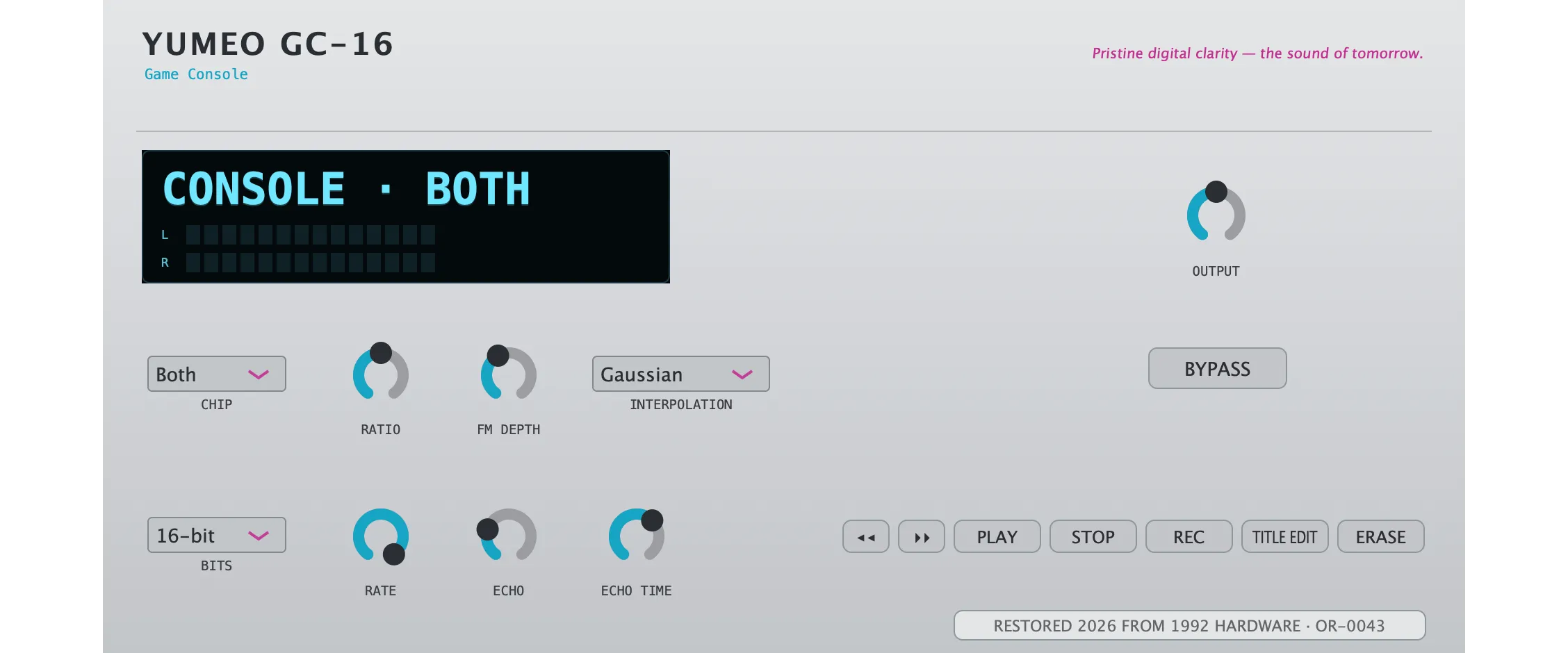
The controls
The controls.
- Chip Both as issued
- Chooses the voice source: FM, the raw chip voice; Sample, that same voice resampled through the console's BRR encoding; or Both, the two layered and detuned for thickness.
- Ratio 0.50–8.00 · 2.00 as issued
- Sets the FM voice's modulator-to-carrier ratio; in Sample or Both mode it also shapes the grain sampled from that same voice.
- FM Depth 0–100 % · 40 % as issued
- Sets the FM voice's modulation index — how strongly the modulator colours the tone; in Sample or Both mode it also shapes the sampled grain.
- Interpolation Gaussian as issued
- Chooses the sample voice's resampling character: Gaussian, matching the original chip; Linear; or None. It has no effect when Chip is set to FM.
- Echo 0–100 % · 25 % as issued
- Sets the depth of the console's built-in echo, a delay with feedback, behind whichever voices are sounding.
- Echo Time 16–240 ms · 120 ms as issued
- Sets the echo buffer's length, which sets the delay time between its repeats.
- Bits 16-bit as issued
- Sets the console's output depth: 16-bit, the clean default; 12-bit, a tonal middle; or 9-bit, the FM chip's own converter depth, with its ladder distortion modelled in.
- Rate 16.0–32.0 kHz · 32.0 kHz as issued
- Sets the console's output sample rate, from 16 to 32 kHz.
- Output -24.00–24.00 dB · 0.00 dB as issued
- Sets the level coming out, in decibels, after the restored circuit and the Mix blend.
- Bypass Off as issued
- Silences the console's voice entirely; with no incoming signal to fall back to, Bypass here mutes rather than passes anything through.
A stored setup is a memory, shown where a track title would sit; the tray reads 03/12 ARCHIVE. The skip keys ◂◂ ▸▸ step through the memories without changing the sound, and PLAY loads the one shown. REC, then PLAY, opens a new memory's name, which starts as USER NN; TITLE EDIT renames a user memory. The skip keys change the letter, TITLE EDIT moves on, and PLAY stores it; the computer keyboard may type the name instead, Return storing and Escape cancelling as STOP does. ERASE clears a user memory on a second press.
Listening
Listening
Demonstration recordings, prepared at the bench.
The console, plainly
A lead over a bass line with Chip set to Both — the FM voice and its sampled double sharing one tune — at the console's default converter, the last chord ringing out through the echo.
0:00 / 0:30
FM, Sample, Both
The same phrase three ways: the raw FM voice, FM Depth and Ratio pushed as it plays; then its sampled double, Interpolation stepping Gaussian to None to Linear; then Both, the two chips layered on one tune.
0:00 / 0:30
The cave
Echo at 80 % with Echo Time at 240 ms — every note answered twice. Bits steps 16, 12, 9 — the 9-bit ladder grinding — while Rate falls to 16 kHz.
0:00 / 0:30