OR-0042
Yumeo
Japan · 1985 – c. 2005
Ser. G-1420788
1993 · instrument
Issued as VST3 · AU
Restored 2026 from 1993 hardware.
Yumeo GX-1 — PC Sound Card
Yumeo GX-1 · PC audio card · restored from unit no. G-1420788 · Yumeo, Japan, 1993
The restorer's note
The card that gave a beige computer a voice — OPL FM synthesis and a hissy 8-bit sample DAC, the exact timbre of a DOS game in 1993. Restored from a socketed original; the aliasing and hiss are as shipped, not as improved.
Acquisition
Prices are exclusive of tax. Customers in a country that charges VAT or sales tax will be liable at the rate set by that country; the relevant amount is added at checkout to the purchase price.
The plate
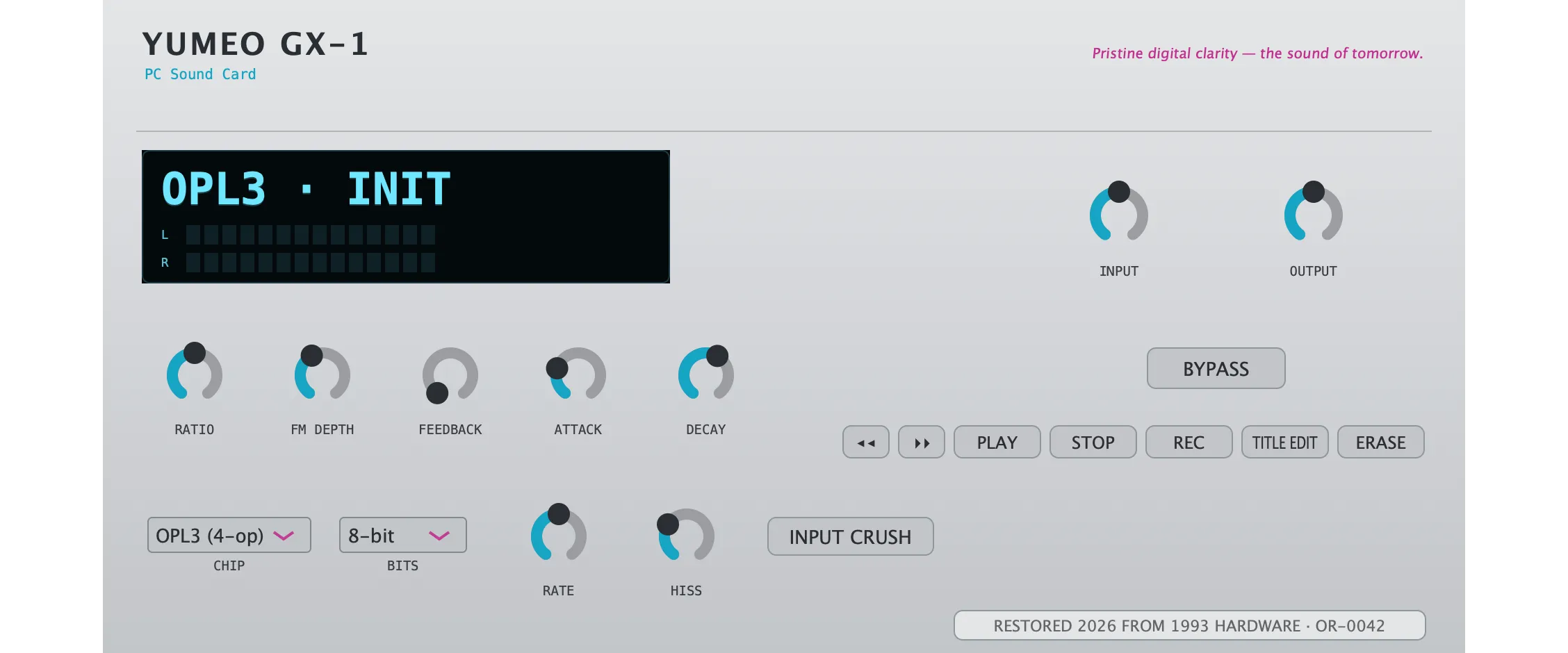
The controls
The controls.
- Chip OPL3 (4-op) as issued
- Chooses the FM engine: OPL2 (2-op), or OPL3 (4-op).
- Ratio 0.50–8.00 · 2.00 as issued
- Sets the modulator-to-carrier frequency ratio of the FM voice.
- FM Depth 0–100 % · 40 % as issued
- Sets the FM modulation index — how strongly the modulator colours the tone.
- Feedback 0–100 % · 0 % as issued
- Sets the amount of operator feedback in the FM voice.
- Attack 0–500 ms · 5 ms as issued
- Sets how quickly each note reaches full volume.
- Decay 20–2000 ms · 500 ms as issued
- Sets how long each note rings before falling silent.
- Rate 8.0–44.0 kHz · 22.0 kHz as issued
- Sets the sample-DAC's rate, from 8 to 44 kHz, that feeds the output stage.
- Bits 8-bit as issued
- Sets the DAC's word length: 8-bit, the card's native grit, or 16-bit, a cleaner alternative.
- Hiss 0–100 % · 30 % as issued
- Sets the card's own noise floor, layered under the output.
- Input Crush Off as issued
- Routes the incoming signal through the card's 8-bit DAC alongside the OPL voice, instead of leaving it untouched.
- Input -24.00–24.00 dB · 0.00 dB as issued
- Trims the incoming signal before Input Crush folds it into the card's output; it has no effect on the OPL voice unless Input Crush is on.
- Output -24.00–24.00 dB · 0.00 dB as issued
- Sets the level coming out, in decibels, after the restored circuit and the Mix blend.
- Bypass Off as issued
- Takes the restored circuit out of the path and passes the untouched signal, delayed to match the circuit so nothing shifts in time.
A stored setup is a memory, shown where a track title would sit; the tray reads 03/12 ARCHIVE. The skip keys ◂◂ ▸▸ step through the memories without changing the sound, and PLAY loads the one shown. REC, then PLAY, opens a new memory's name, which starts as USER NN; TITLE EDIT renames a user memory. The skip keys change the letter, TITLE EDIT moves on, and PLAY stores it; the computer keyboard may type the name instead, Return storing and Escape cancelling as STOP does. ERASE clears a user memory on a second press.
Listening
Listening
Demonstration recordings, prepared at the bench.
OPL, plainly
A lead and its chords from the OPL3 engine at bench settings, through the card's own 8-bit converter. At fifteen seconds Attack and Decay open out, and the same voice swells instead of plucking.
0:00 / 0:30
Four operators, then two
The phrase repeats four ways: OPL3 at bench settings; OPL2's two-operator voice; OPL3 again with Ratio at 4.0; then FM Depth at 80 % with Feedback at 60 %. The card's whole vocabulary, in order.
0:00 / 0:30
Through the eight-bit DAC
Input Crush routes a full mix through the card's own converter. Rate falls to 11 kHz, Hiss climbs to 80 %, and Bits flips briefly to 16 before settling back where the card lives — at 8.
0:00 / 0:30