OR-0040
Yumeo
Japan · 1985 – c. 2005
Ser. F-0092233
1991 · effect
Issued as VST3 · AU
Restored 2026 from 1991 hardware.
Yumeo HF-1 — Sampler Filter
Yumeo HF-1 · resonant filter unit · restored from unit no. F-0092233 · Yumeo, Japan, 1991
The restorer's note
The onboard filter of a consumer digital instrument, offered two ways: smooth analog warmth, or the zipper of an early digital IIR sweeping in coarse steps. Both are original behaviours. Here the zipper is a feature, as it never was there.
Acquisition
Prices are exclusive of tax. Customers in a country that charges VAT or sales tax will be liable at the rate set by that country; the relevant amount is added at checkout to the purchase price.
The plate
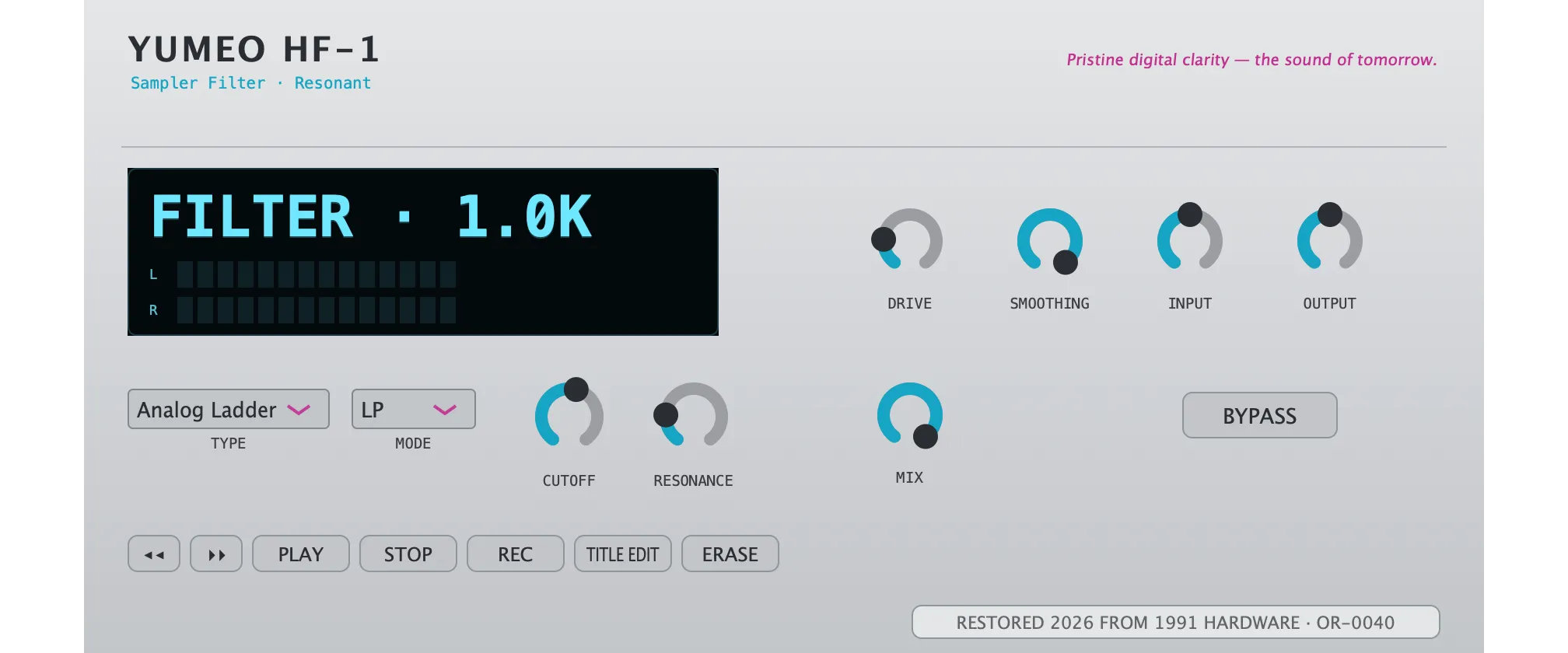
The controls
The controls.
- Type Analog Ladder as issued
- Chooses the filter's engine: Analog Ladder, Analog SVF, or Digital IIR.
- Cutoff 20 Hz–20.0 kHz · 1.0 kHz as issued
- Sets the filter's corner frequency.
- Resonance 0–100 % · 20 % as issued
- Sets how strongly the filter emphasizes its corner, self-oscillating as it nears the top.
- Mode LP as issued
- Chooses the filter's response: LP, BP, or HP.
- Drive 0–100 % · 20 % as issued
- Sets the amount of nonlinearity driven into the filter ahead of its corner.
- Smoothing 0–100 % · 100 % as issued
- Sets how smoothly Cutoff moves between values; set low, it leaves the Digital IIR's coefficient steps bare — the zipper, kept here as a feature.
- Input -24.00–24.00 dB · 0.00 dB as issued
- Sets the level going in, in decibels, before the signal reaches the restored circuit.
- Output -24.00–24.00 dB · 0.00 dB as issued
- Sets the level coming out, in decibels, after the restored circuit and the Mix blend.
- Mix 0–100 % · 100 % as issued
- Blends the restored circuit against the untouched signal at equal power, from the untouched signal alone at 0 % to the circuit alone at 100 %.
- Bypass Off as issued
- Takes the restored circuit out of the path and passes the untouched signal, delayed to match the circuit so nothing shifts in time.
A stored setup is a memory, shown where a track title would sit; the tray reads 03/12 ARCHIVE. The skip keys ◂◂ ▸▸ step through the memories without changing the sound, and PLAY loads the one shown. REC, then PLAY, opens a new memory's name, which starts as USER NN; TITLE EDIT renames a user memory. The skip keys change the letter, TITLE EDIT moves on, and PLAY stores it; the computer keyboard may type the name instead, Return storing and Escape cancelling as STOP does. ERASE clears a user memory on a second press.
Listening
Listening
Demonstration recordings, prepared at the bench.
The ladder, plainly
Chords through the Analog Ladder: dry, then filtered at 400 Hz, then Cutoff swept up to 8 kHz and back down with Resonance at 45 %. The sampler's front panel, doing its plain job.
0:00 / 0:30
Three filters
Resonance at 80 % while Cutoff sweeps; Type steps Analog Ladder, Analog SVF, Digital IIR — the same move, three tempers.
0:00 / 0:30
The zipper
Smoothing at nought, Drive at 80 %. Cutoff moves in deliberate steps — an A-minor arpeggio of corner frequencies — and every step clicks. In Digital IIR, un-smoothed, that zipper is the point.
0:00 / 0:30