OR-0041
Yumeo
Japan · 1985 – c. 2005
Ser. K-0330512
1995 · effect
Issued as VST3 · AU
Restored 2026 from 1995 hardware.
Yumeo KM-1 — Karaoke Machine
Yumeo KM-1 · karaoke unit · restored from unit no. K-0330512 · Yumeo, Japan, 1995
The restorer's note
The living-room karaoke deck — the crude centre-channel trick that pulls the lead vocal out of a record, and the splashy reverb it pours over a microphone. Cheap, joyful, and instantly 1995. Restored complete, key-shift and all.
Acquisition
Prices are exclusive of tax. Customers in a country that charges VAT or sales tax will be liable at the rate set by that country; the relevant amount is added at checkout to the purchase price.
The plate
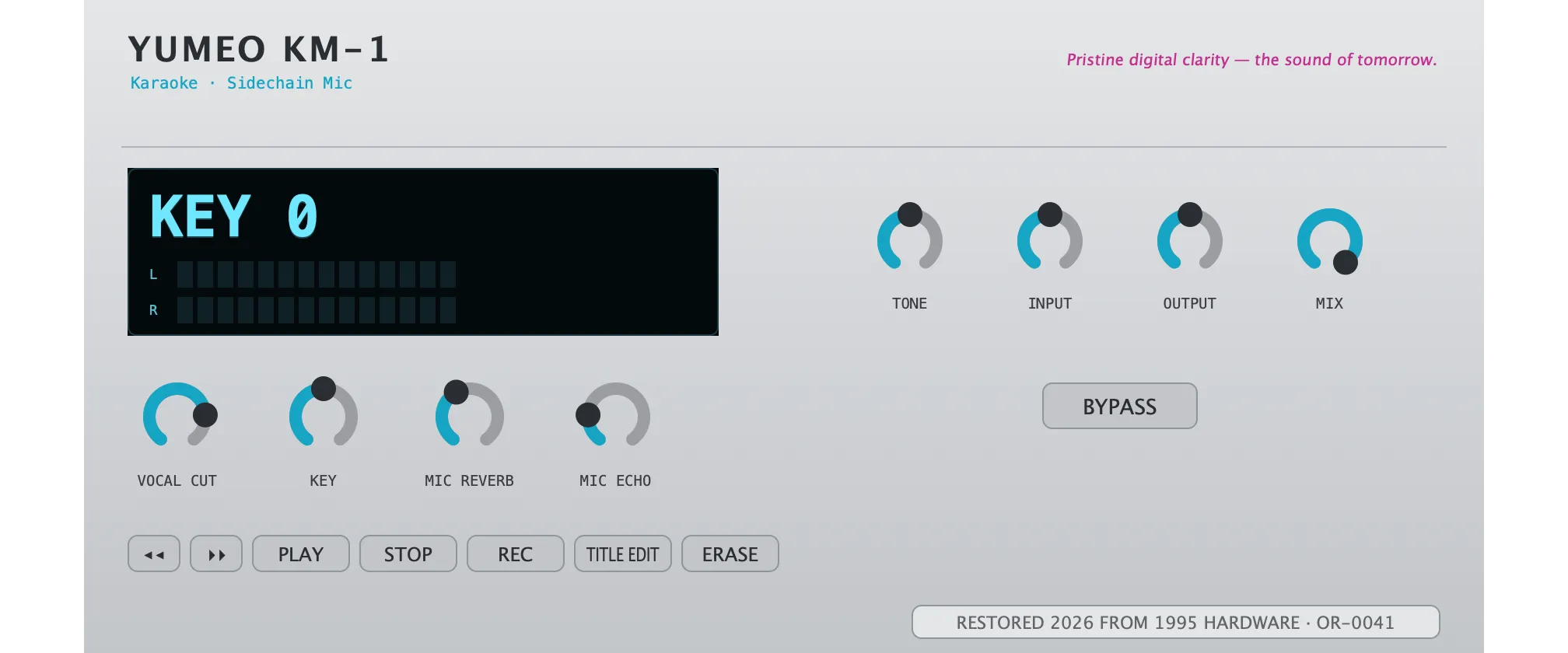
The controls
The controls.
- Vocal Cut 0–100 % · 80 % as issued
- Sets how much of the record's centre-panned content — typically the lead vocal — is cancelled from the mix before the key shift.
- Key -12–12 st · 0 st as issued
- Shifts the backing track's pitch, in semitones, to fit your range.
- Mic Reverb 0–100 % · 40 % as issued
- Sets how much splashy reverb is poured over the microphone path.
- Mic Echo 0–100 % · 20 % as issued
- Sets how much slap echo is added to the microphone path.
- Tone -12.0–12.0 dB · 0.0 dB as issued
- Tilts the cheap karaoke tone, lifting the highs and cutting the lows above zero, or the reverse below it, in decibels.
- Input -24.00–24.00 dB · 0.00 dB as issued
- Trims the backing-track signal before the vocal cut, in decibels; the microphone input is unaffected.
- Output -24.00–24.00 dB · 0.00 dB as issued
- Sets the level coming out, in decibels, after the restored circuit and the Mix blend.
- Mix 0–100 % · 100 % as issued
- Blends the vocal-cut, key-shifted backing against the untouched backing, at equal power; the microphone's reverb and echo fade out with it, since both ride the same blend.
- Bypass Off as issued
- Takes the vocal cut, key shift, and the microphone's reverb and echo out of the path, and passes the untouched backing alone.
A stored setup is a memory, shown where a track title would sit; the tray reads 03/12 ARCHIVE. The skip keys ◂◂ ▸▸ step through the memories without changing the sound, and PLAY loads the one shown. REC, then PLAY, opens a new memory's name, which starts as USER NN; TITLE EDIT renames a user memory. The skip keys change the letter, TITLE EDIT moves on, and PLAY stores it; the computer keyboard may type the name instead, Return storing and Escape cancelling as STOP does. ERASE clears a user memory on a second press.
Listening
Listening
Demonstration recordings, prepared at the bench.
The voice, pulled
The song plays untouched for five seconds; the machine then takes the line and Vocal Cut, at 80 %, pulls the centred voice out of it. At eighteen seconds it goes to 100 and the null deepens.
0:00 / 0:30
Off-key, then empty
Key drops three semitones, rises three, and returns — the machine's granular shift wobbling as it goes. Vocal Cut then sweeps from nought to full, and the singer leaves the room.
0:00 / 0:30
The mic path
A voice arrives on the mic input over the cut backing — Mic Reverb at 80 %, Mic Echo at 60 %, splashy on purpose — and Tone tilts down eight decibels at twenty seconds.
0:00 / 0:30