OR-0035
Yumeo
Japan · 1985 – c. 2005
Ser. M-2170534
1994 · effect
Issued as VST3 · AU
Restored 2026 from 1994 hardware.
Yumeo MD-1 — MiniDisc (ATRAC)
Yumeo MD-1 · ATRAC recorder · restored from unit no. M-2170534 · Yumeo, Japan, 1994
The restorer's note
A generation's first "perfect" digital recorder, and the gentle softening of transients and stereo that ATRAC left behind. The restored unit — number 2,170,534 off the line — was, like most surviving MD decks, barely used: obsolete before it could wear out. The character is the codec, and we kept all of it.
Acquisition
Prices are exclusive of tax. Customers in a country that charges VAT or sales tax will be liable at the rate set by that country; the relevant amount is added at checkout to the purchase price.
The plate
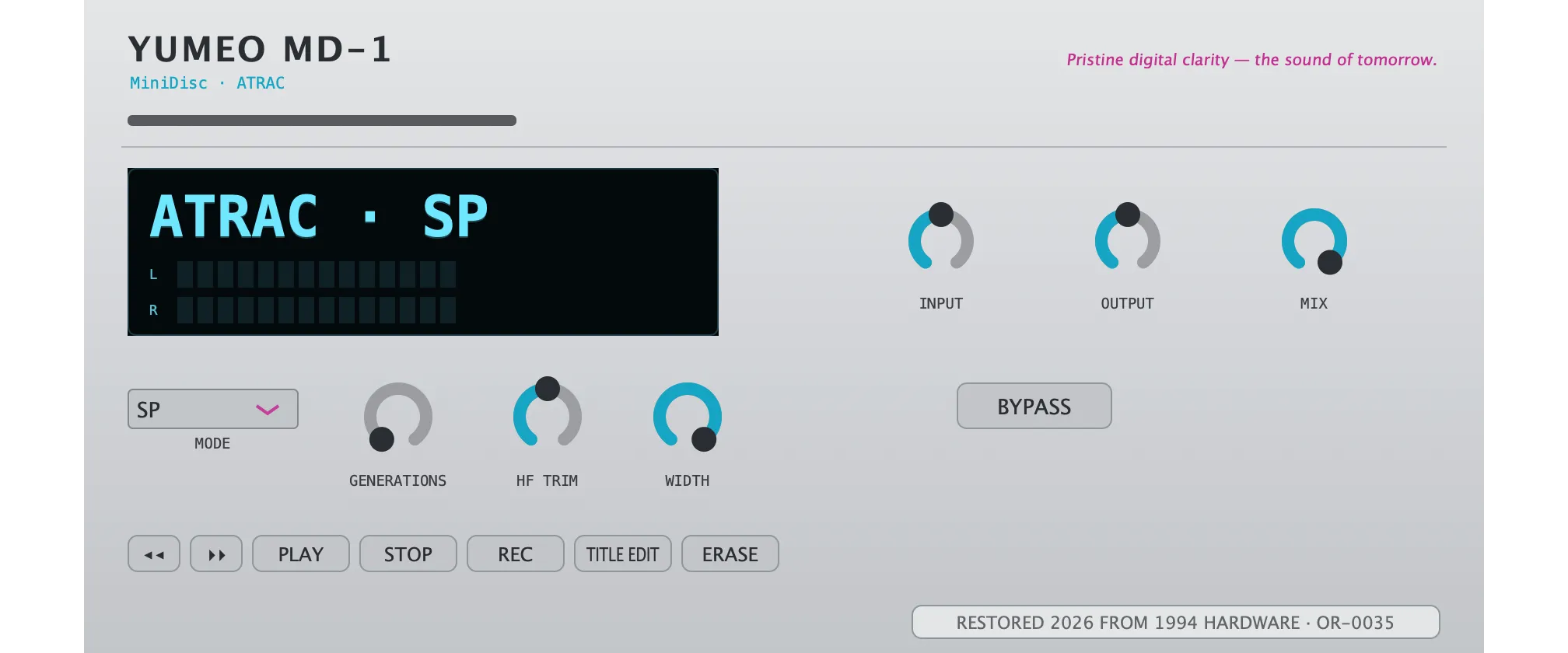
The controls
The controls.
- Mode SP as issued
- Chooses the bit-allocation aggressiveness: SP, LP2, or LP4.
- Generations 1–8 · 1 as issued
- Runs the signal through the ATRAC codec this many times over, layering each copy's loss the way dubbing from one MiniDisc to another would.
- HF Trim -12.0–12.0 dB · 0.0 dB as issued
- Sets a high shelf after the codec, lifting or cutting the top end, in decibels.
- Width 0–100 % · 100 % as issued
- Sets the stereo width after the codec, from fully mono at 0 % to the original image at 100 %; lower settings mimic ATRAC's intensity-stereo narrowing.
- Input -24.00–24.00 dB · 0.00 dB as issued
- Sets the level going in, in decibels, before the signal reaches the restored circuit.
- Output -24.00–24.00 dB · 0.00 dB as issued
- Sets the level coming out, in decibels, after the restored circuit and the Mix blend.
- Mix 0–100 % · 100 % as issued
- Blends the restored circuit against the untouched signal at equal power, from the untouched signal alone at 0 % to the circuit alone at 100 %.
- Bypass Off as issued
- Takes the restored circuit out of the path and passes the untouched signal, delayed to match the circuit so nothing shifts in time.
A stored setup is a memory, shown where a track title would sit; the tray reads 03/12 ARCHIVE. The skip keys ◂◂ ▸▸ step through the memories without changing the sound, and PLAY loads the one shown. REC, then PLAY, opens a new memory's name, which starts as USER NN; TITLE EDIT renames a user memory. The skip keys change the letter, TITLE EDIT moves on, and PLAY stores it; the computer keyboard may type the name instead, Return storing and Escape cancelling as STOP does. ERASE clears a user memory on a second press.
Listening
Listening
Demonstration recordings, prepared at the bench.
ATRAC, plainly
The mix runs dry, then through the recorder at SP from five seconds. What ATRAC discards at standard play is quiet — listen to the cymbal tails and the space around things, not the middle of the mix.
0:00 / 0:30
Three speeds down
Mode steps SP to LP2 to LP4, the allocator coarsening each time. Back at SP, Generations then climbs to eight — a dub of a dub of a dub, and the loss compounds.
0:00 / 0:30
Narrow, and dark
LP4 throughout. HF Trim shelves the top down eight decibels at eight seconds, and Width then narrows to 20 % — the intensity-stereo image folding toward the centre.
0:00 / 0:30
The exhibit
The exhibit.
