OR-0038
Yumeo
Japan · 1985 – c. 2005
Ser. P-0489150
1999 · effect
Issued as VST3 · AU
Restored 2026 from 1999 hardware.
Yumeo MP-3 — Perceptual Coder
Yumeo MP-3 · perceptual audio coder · restored from unit no. P-0489150 · Yumeo, Japan, 1999
The restorer's note
The exact swirl of a 128k file traded over a dial-up line — cymbals turning to water, the stereo image folding inward. Yumeo's catalogue called it "CD quality, anywhere." It was not, quite, and that gap is now the effect. Preserved with affection.
Acquisition
Prices are exclusive of tax. Customers in a country that charges VAT or sales tax will be liable at the rate set by that country; the relevant amount is added at checkout to the purchase price.
The plate
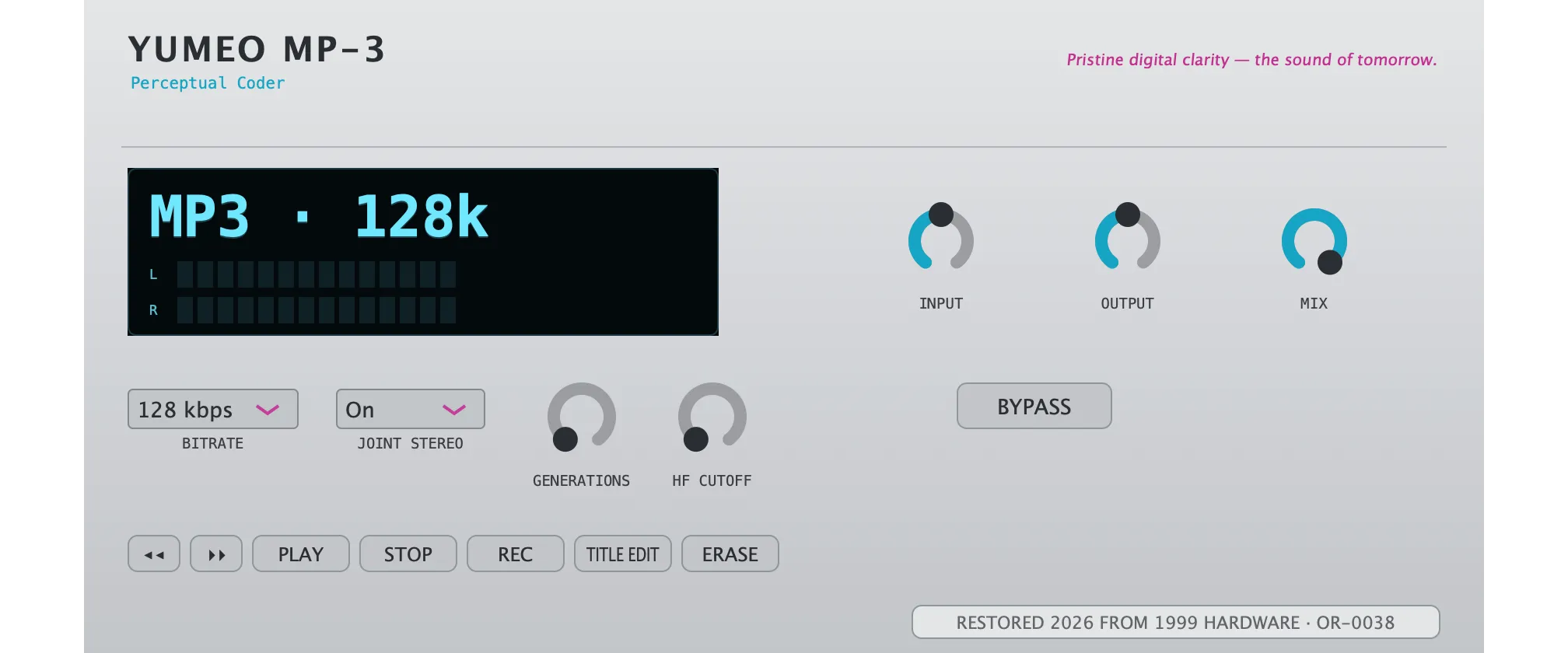
The controls
The controls.
- Bitrate 128 kbps as issued
- Sets the coded bitrate: 32, 40, 48, 56, 64, 80, 96, 112, 128, 160, 192, 224, 256, or 320 kbps. Lower rates leave the masking model less room, so more is discarded.
- Generations 1–8 · 1 as issued
- Runs the signal through the encoder this many times over, layering each re-encoded copy's loss.
- Joint Stereo On as issued
- Chooses whether the encoder folds the stereo image down to intensity-coded mono: Off, or On.
- HF Cutoff Auto–20.0 kHz · Auto as issued
- Sets the low-pass the encoder applies ahead of coding, from 6 to 20 kHz, or leaves it on Auto, which follows the chosen bitrate.
- Input -24.00–24.00 dB · 0.00 dB as issued
- Sets the level going in, in decibels, before the signal reaches the restored circuit.
- Output -24.00–24.00 dB · 0.00 dB as issued
- Sets the level coming out, in decibels, after the restored circuit and the Mix blend.
- Mix 0–100 % · 100 % as issued
- Blends the restored circuit against the untouched signal at equal power, from the untouched signal alone at 0 % to the circuit alone at 100 %.
- Bypass Off as issued
- Takes the restored circuit out of the path and passes the untouched signal, delayed to match the circuit so nothing shifts in time.
A stored setup is a memory, shown where a track title would sit; the tray reads 03/12 ARCHIVE. The skip keys ◂◂ ▸▸ step through the memories without changing the sound, and PLAY loads the one shown. REC, then PLAY, opens a new memory's name, which starts as USER NN; TITLE EDIT renames a user memory. The skip keys change the letter, TITLE EDIT moves on, and PLAY stores it; the computer keyboard may type the name instead, Return storing and Escape cancelling as STOP does. ERASE clears a user memory on a second press.
Listening
Listening
Demonstration recordings, prepared at the bench.
128k, plainly
The mix runs dry, then through the coder at 128 kbps. The loss sits at the top and in the space between things — present, but polite, exactly as the era heard it.
0:00 / 0:30
The bitrate ladder
Bitrate steps down the ladder — 320, 192, 128, 64, 32 kbps. Somewhere past 64 the swirl arrives and stays; the band narrows with every rung.
0:00 / 0:30
Eighth generation
Eight Generations at 64 kbps, Joint Stereo off, then on — the coder splitting, then pooling, its budget — and HF Cutoff finally pinned at 6 kHz. A file passed around until this is what remains.
0:00 / 0:30