OR-0039
Yumeo
Japan · 1985 – c. 2005
Ser. R-0412783
1993 · effect
Issued as VST3 · AU
Restored 2026 from 1993 hardware.
Yumeo RV-1 — PureDigital Reverb
Yumeo RV-1 · digital reverb unit · restored from unit no. R-0412783 · Yumeo, Japan, 1993
The restorer's note
The reverb baked into a consumer deck's chip — short, sparse, metallic, the unglamorous grit the expensive boxes spent fortunes to avoid. Which is exactly why it sounds like nothing else today. Restored from an unremarkable, and therefore perfect, unit.
Acquisition
Prices are exclusive of tax. Customers in a country that charges VAT or sales tax will be liable at the rate set by that country; the relevant amount is added at checkout to the purchase price.
The plate
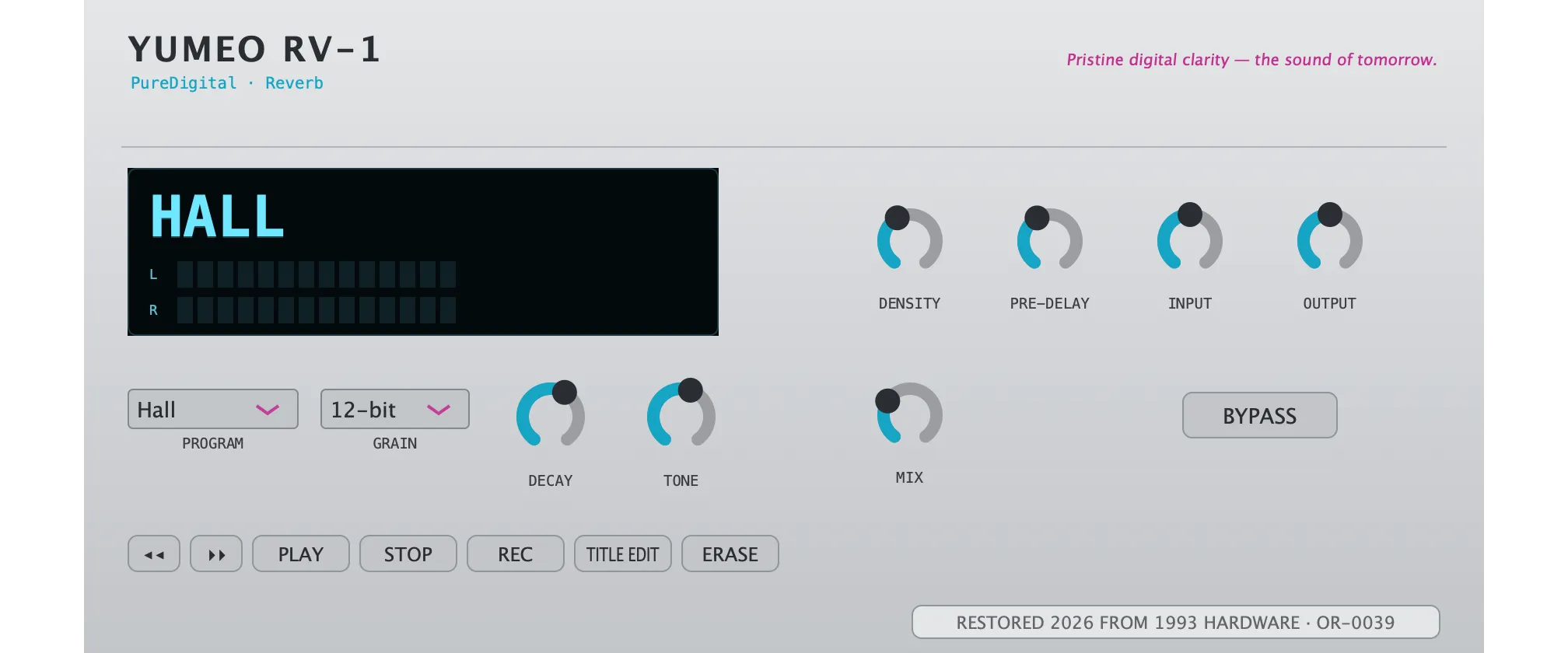
The controls
The controls.
- Program Hall as issued
- Chooses the cheap-chip room — topology and density together: Hall, Room, Plate, Stage, or Vocal.
- Decay 0.20–5.00 s · 1.50 s as issued
- Sets how long the tank's feedback rings on, from 0.2 to 5 seconds, the short range of the original box.
- Tone 1.0–16.0 kHz · 5.0 kHz as issued
- Sets the high-frequency damping inside the feedback loop, from 1 to 16 kHz — the metallic colouring of the tail.
- Density 0–100 % · 40 % as issued
- Sets how many combs and allpasses run, from thin at 0 % to the fullest this chip allows at 100 % — it stays sparse throughout.
- Grain 12-bit as issued
- Chooses the delay memory's word length: 12-bit, the grittier original, or 16-bit, a cleaner alternative.
- Pre-delay 0–100 ms · 10 ms as issued
- Sets a silent gap before the tail begins.
- Input -24.00–24.00 dB · 0.00 dB as issued
- Sets the level going in, in decibels, before the signal reaches the restored circuit.
- Output -24.00–24.00 dB · 0.00 dB as issued
- Sets the level coming out, in decibels, after the restored circuit and the Mix blend.
- Mix 0–100 % · 30 % as issued
- Blends the restored circuit against the untouched signal at equal power, from the untouched signal alone at 0 % to the circuit alone at 100 %.
- Bypass Off as issued
- Takes the restored circuit out of the path and passes the untouched signal, delayed to match the circuit so nothing shifts in time.
A stored setup is a memory, shown where a track title would sit; the tray reads 03/12 ARCHIVE. The skip keys ◂◂ ▸▸ step through the memories without changing the sound, and PLAY loads the one shown. REC, then PLAY, opens a new memory's name, which starts as USER NN; TITLE EDIT renames a user memory. The skip keys change the letter, TITLE EDIT moves on, and PLAY stores it; the computer keyboard may type the name instead, Return storing and Escape cancelling as STOP does. ERASE clears a user memory on a second press.
Listening
Listening
Demonstration recordings, prepared at the bench.
The hall, plainly
Sticks and hits, dry, then into the Hall program at the factory Mix of 30 % — raised to 80 % at eighteen seconds so the tank itself can be heard. It is small, the tail is metallic, and neither is an accident.
0:00 / 0:30
Five programs, one chip
Program walks Hall, Room, Plate, Stage, Vocal — the same sparse chip wearing five names. On Vocal, Decay snaps to 0.2 seconds and then opens out to the full five.
0:00 / 0:30
Dark, sparse, twelve bits
Tone at 1 kHz, Density at 10 %, Pre-delay at 60 ms — a dark, clangy, deliberate space. At fourteen seconds Grain drops from 16-bit to 12-bit and the tail picks up its grit.
0:00 / 0:30